The Green Way 2024: in review
News
23 Jan 2024
Environment, Energy
The Green Way 2024: in review

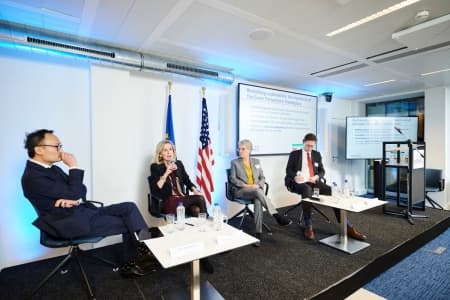
AmCham EU’s ‘The Green Way: growing sustainable supply chains’ conference took place on Tuesday, 23 January 2024 and explored how we can maximise the benefits of the tools available to swiftly enable the green transition. Whether it was through international environmental reporting standards, access to capital or more, attendees learned what needs to happen to modernise our approach to sustainability. Read more about what we learned throughout the day. 

Welcoming everyone was Susan Danger, CEO, AmCham EU and Liam Benham (Boeing), Chair, AmCham EU who both emphasised the need for an openness to technology, funding and transatlantic cooperation. 

The first panel focused on the Green Transatlantic Marketplace and how we can modernise our approach to sustainability. Panelists covered the need for clear joint standards for clean technologies, transatlantic collaboration for research and development, and the need for public-private partnerships. The panel featured Matthias Jorgensen, Head of Unit, USA and Canada, Directorate-General for Trade, European Commission; Ann Mettler, Vice-President, Europe, Breakthrough Energy and LeAnn Ridgeway, Chief Sustainability Officer, Collins Aerospace. Moderating the panel was Hosuk Lee-Makiyama, Director, European Centre for International Political Economy. By supporting the green transatlantic marketplace through frameworks like the Carbon Border Adjustment Mechanism (CBAM), we can accelerate a global green transition and avoid unintended trade barriers. 

After a short coffee break, attendees were welcomed by Daniel Michaels, Brussels Bureau Chief, The Wall Street Journal for a panel discussion focused on digital solutions for sustainable growth. The conversation was drawn towards the growing importance of artificial intelligence and the need to use digital tools to gather data to modernise energy systems. During the panel we heard from Vincent Berutto, Head of Unit, Digitalisation, Competitiveness, Research and Innovation, Directorate-General for Energy, European Commission; Miapetra Kumpula-Natri, MEP (S&D, FI); Jake Oster, Director, Energy and Environment Policy, Europe, Middle East and Africa, Amazon Web Services and Maria Spyraki, MEP (EPP, EL). 

Following the lunch break Allyson Anderson Book, Chief Sustainability Officer, Baker Hughes; Peter Handley, Deputy Director-General and Chief Standardisation Officer, Energy Intensive Industries, Raw Materials, Hydrogen, Directorate-General for Internal Market, Industry, Entrepreneurship and SMEs, European Commission; Przemek Kowalski, Senior Trade Policy Analyst, OECD and Maria-Antoinetta Simons, Deputy Chief, Cabinet of Tinne Van der Straeten, Belgian Minister of Energy took to the stage to  discuss global cooperation on responsible supply chains and the green transition. De-risking, diversifying and being inclusive to everyone along the supply chain were some of the solutions covered. Moderating the panel was Ricardo Borges de Castro, Associate Director and Head, Europe in the World Programme, European Policy Centre. By avoiding unnecessary administrative and regulatory burdens, industry can be given the investment certainty it needs to secure the green transition through a reliable supply of Critical Raw Materials. 

Closing the conference was a conversation around how to finance the green transition. Joining our moderator, Heather Grabbe, Senior Fellow, Bruegel, was David Henry Doyle, Vice-President, Head of Government Affairs and Public Policy, Europe, Middle East and Africa, S&P Global; Norine Kennedy, Senior Vice-President, Policy and Global Strategy, United States Council for International Business and Martin Spolc, Head of Unit, Sustainable Finance, Directorate-General for Financial Stability, Financial Services and Capital Markets Union, European Commission. From the panel, it was clear strong capital markets and harmonised cross border rules are needed for us to reach environmental targets. Following the discussions, attendees enjoyed a networking reception and showcasing of the Green Way Campaign

From environmental programs, health initiatives and beyond, American companies are committed to investing in people and communities across Europe. Check out our Invested in Europe platform for examples of how American companies are driving the green transition across Europe. 

Related items

News
29 Apr 2026

Revision of the Classification, Labelling and Packaging Regulation: Following a balanced Report, trilogues must secure simplification

Today, the European Parliament adopted its Omnibus VI report, including the revision of the Classification, Labelling and Packaging (CLP) Regulation, by 540 votes to 60. The outcome supports a more streamlined framework by easing the regulatory burden on value chains that rely on chemicals and sending a positive signal of the EU’s commitment to reducing unnecessary complexity.

With the Council’s position agreed in November 2025, the Parliament’s report marks the final step before trilogues, which will conclude negotiations on the targeted revision of the CLP Regulation.

The report largely aligns with the Commission’s simplification agenda and strengthens the CLP Regulation’s overall workability, especially with regards to:

  • Transition periods, setting 18 months following classification updates and allowing digital contact information to be updated on the label in line with suppliers’ regular update cycles. This better reflects supply chain realities.

  • Advertising and distance sales requirements, appropriately excluding business-to-business settings while ensuring consumers remain protected; and

  • Label legibility requirements, with more proportionate minimum font sizes and rules on background contrast, spacing and overall layout. However, further simplification is still needed to ensure sufficient flexibility for businesses.

While the report represents a constructive step forward, trilogues should address remaining constraints and clarify language that is currently difficult to interpret, including further simplification on font sizes and advertising requirements in business-to-consumer settings. These negotiations should draw on the more proportionate approaches of the Commission and the Council.

Maintaining a strong focus on simplification will be key to further alleviating administrative burdens and strengthening the EU’s resilience and competitiveness.

Environment
Read more
Read more about Revision of the Classification, Labelling and Packaging Regulation: Following a balanced Report, trilogues must secure simplification
Position Paper
29 Apr 2026

Simplifying the Classification, Labelling and Packaging Regulation: recommendations for trilogues

On 8 July 2025, the Commission presented the Omnibus VI simplification package, reopening key legislation such as the CLP Regulation, which entered into force in December 2024. The Omnibus addresses overlaps and inconsistencies that create practical challenges and, in some cases, make compliance unworkable.


Upcoming trilogues can streamline the framework and reduce unnecessary burdens. This paper sets out targeted recommendations on the positions that can achieve meaningful simplification during the inter-institutional negotiations.

Environment
Read more
Read more about Simplifying the Classification, Labelling and Packaging Regulation: recommendations for trilogues
Position Paper
21 Apr 2026

Industrial Accelerator Act: keeping Europe competitive and open to investment

The Industrial Accelerator Act will be a key test of whether the EU can strengthen industrial competitiveness while advancing decarbonisation. With significant pressure already weighing on businesses in Europe, from high energy costs and supply chain disruptions to unnecessary red tape and intensifying global competition, getting that balance right matters. If Europe fails to send clear signals that it remains a predictable place to invest, capital will go elsewhere.

AmCham EU supports the objectives of the IAA, but its success will depend on how it is designed. A central question in the debate is how ‘European preference’ should be approached. Strengthening Europe’s economic resilience and security is a legitimate objective. However, an approach that creates uncertainty for companies from partner countries, particularly by leaving key decisions to secondary legislation, risks undermining investment and limiting access to the technologies needed for the transition.

The focus should instead be on providing clarity early and rewarding companies that create real EU-added value through manufacturing, R&D, skills and emissions reductions. Learn more in our full paper.

Industry
Energy
Read more
Read more about Industrial Accelerator Act: keeping Europe competitive and open to investment