Emerging areas for EU-US cooperation
The transatlantic economy remains the largest, most prosperous and most innovative of its kind in the world – and it continues to grow. The EU and the US should seize the renewed optimism and positive momentum to advance and deepen the world’s largest trade and investment relationship. While they can build on decades of efforts to enhance regulatory cooperation and remove barriers to trade and investment, they should also address new and emerging issues that arise from the transformation of our economies. In a new document, the American Chamber of Commerce to the EU (AmCham EU) presents ideas for EU-US cooperation across a wide range of sectors and industries. Read more here.

Related items
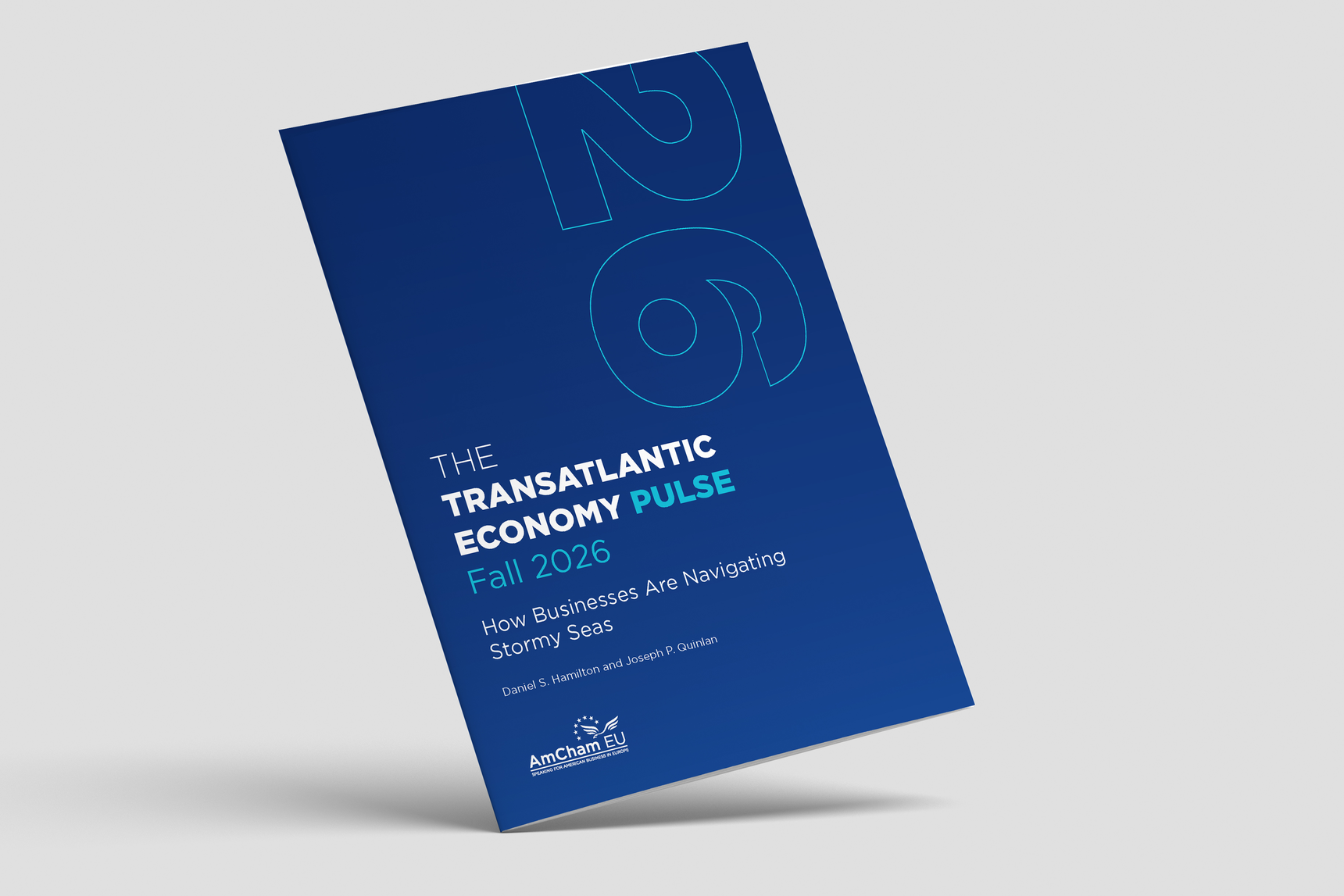
The Transatlantic Economy Pulse 2026
How are companies adjusting to an evolving transatlantic trade environment? In a year so far marked by geopolitical tensions and economic uncertainty, The Transatlantic Economy Pulse identifies trade and investment trends between Europe and the US in the first half of 2026.

Why stability and openness matter for transatlantic investment
On Wednesday, 21 October 2026, Thibaut L’Ortye, Chief Policy and Public Affairs Officer, AmCham EU, addressed MEPs with Brando Benifei, MEP (S&D, IT) and Chair, and Eva Maydell, MEP (EPP, BG) and Vice-Chair, European Parliament Delegation for relations with the United States. Taking place at the European Parliament in Strasbourg, France, he presented the latest trade and investment data alongside Daniel Hamilton, co-author of The Transatlantic Economy, stressing that behind the headlines lies the world’s most integrated economic relationship, worth around €8 trillion. He underlined that stability and predictability are essential, urging both sides to build on the Turnberry agreement. He also called for Europe’s industrial strategy to keep the Single Market open to investment. Read more in the latest Transatlantic Economy Pulse.

Export controls fit for today's economy
The Dual-Use Regulation gives Europe a common framework for economic security, but divergent national implementation is weakening it. The same transaction can be assessed differently depending on the Member State, with guidance on cloud and software-as-a-service transfers remains unclear. Licensing processes, meanwhile, still assume a physical consignment rather than digital workflows, which sits poorly with how integrated global businesses operate. Companies bear the added cost and legal uncertainty, while the security benefit is limited. A single EU-wide approach to intangible transfers and closer alignment with the US and UK would make controls more predictable and let authorities focus on genuine risks. Read how the revision of the Dual-Use Regulation can deliver a harmonised and future-proof framework for Europe.
Policy priorities
Insights and advocacy driving Europe’s policy agenda. Our priorities support growth, innovation and a stronger transatlantic economy.
Membership
Connecting business and policymakers to strengthen the voice of American companies in Europe.