Transatlantic relations beyond the EU: The role of AmChams in Europe

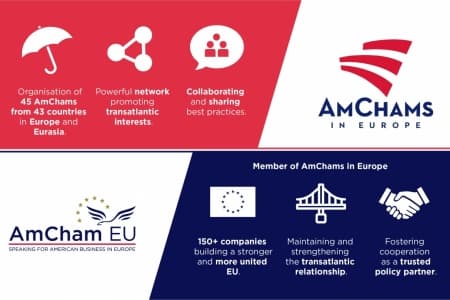
As of Wednesday, 1 January 2020, Susan Danger has been confirmed Chair of the AmChams in Europe network for the 2020-2022 period. AmChams in Europe is an umbrella organisation that encompasses 45 AmChams from 43 countries across Europe. AmCham EU is one of the members of this network. The position of Chair is a rotating post, with a two-year tenure. Susan takes over from Patrik Mikkelsen of AmCham The Netherlands after his tenure came to an end at the end of 2019.

Read Susan's latest LinkedIn article on her new position as Chair of AmChams in Europe. 

News
10 Feb 2020
Transatlantic relations beyond the EU: The role of AmChams in Europe

AmChams in Europe is a platform for the chambers to exchange best practices. They meet twice a year – once in Europe and once in the US. The principal aim of the organisation is to share information and knowledge among the membership, as each chamber works independently towards the common goal of representing transatlantic business interests in their respective jurisdictions.

AmChams in Europe is a useful network to reinforce the efforts of individual AmChams. Some of the ways in which the network does this are: the coordination across the network of AmChams in the publication of certain materials, the development of toolkits, and sharing of good practices and lessons learnt in advocacy. The network has also served the purpose of sharing contacts for the organisation of high-level meetings or speakers for events.

Susan’s uptake of this second role is a great opportunity, both for her in a personal and professional capacity, and for AmCham EU. Given that Susan has already played an active role in the network for 17 years, she aims to fully utilise the knowledge, relationships and contacts she has developed to date. Susan looks forward to working with her colleagues across the network and in particular with AmCham Slovenia, the current host of the AmChams in Europe Secretariat.

In a challenging global context that has seen the multilateral, rules-based order come under threat from the re-emergence of tariff wars, which serve to fracture trade flows across borders, it is more important than ever for businesses to speak out with a strong voice. AmChams in Europe is the ambassador for transatlantic businesses invested in the EU and wider Europe. In collaboration with other Chambers, we can continue to shape the voice of business, providing a positive message about the importance of global trade. Storytelling must gain equal footing with fact-based advocacy, in order to win the hearts and minds of the wider public. By sharing experiences, and learning from each other, the AmChams in Europe network is a great resource to elaborate, share and amplify such positive messages. We look forward to the next two years and the opportunities that they can bring.

Related items

News
22 Jul 2026

Banking Competitiveness Report: Single Market integration and openness must drive reform

The European Commission’s Banking Competitiveness Report comes at a critical moment for Europe’s investment agenda. Closing Europe’s investment gap requires a banking sector able to mobilise capital at the scale the Savings and Investments Union demands. This is dependent on a Single Market that is not only competitive and integrated but open for all banks operating in the EU to act as facilitators of investment. The report provides a window of opportunity to anchor that openness at the centre of the competitiveness agenda.

The report correctly identifies a set of barriers holding back Europe’s banking competitiveness, both in the regulatory framework and in the way that framework is supervised. Undue complexity and divergent national implementation continue to raise the cost of financing for European households and businesses, underlining the need for an ambitious banking omnibus that simplifies rules and delivers greater consistency across the EU. At the same time, the report is right to call for a more proportionate, risk-focused supervisory culture that examines whether burdensome practices are weakening the attractiveness of Europe’s banking ecosystem. A new banking competitiveness agenda should build on both priorities: simpler, more coherent rules and supervision that enables internationally active banks to support investment.

Internationally active banks, including third-country groups with a substantial European footprint, are central to delivering this agenda. These institutions channel global capital to European companies, underpin the liquidity and depth of EU capital markets and help international investors finance opportunities in Europe. Europe remains a strategic market for these firms, and their investment demonstrates confidence in European growth, European companies and European opportunity.

The test of genuine integration is whether a banking group can serve customers across the Single Market without rebuilding its operations in each Member State. The report recognises that divergent national application of EU rules discourages banks from offering pan-European services and consequently results in costly duplication and regulatory burden across jurisdictions. A more competitive framework would enable European and international institutions to thrive in Europe, offering clients choice and a full suite of payment and banking services across the Single Market.

Coherent implementation will determine whether these reforms enhance competitiveness. Where the framework adapts international standards to EU specificities, the test should be whether the result preserves a level playing field for banks competing in global markets and remains consistent with the standards those banks apply across jurisdictions.

Financial services
Read more
Read more about Banking Competitiveness Report: Single Market integration and openness must drive reform
Position Paper
20 Jul 2026

Principles for economically efficient and growth-compatible tax reform in the EU

The Draghi report highlights how economic growth has stagnated in the EU due to structural weaknesses that risk undermining the EU’s global competitiveness. To bolster the EU’s attractiveness and competitiveness, lawmakers should pursue a coherent pro-growth tax reform agenda. A pro-growth tax reform agenda in the EU27 can be evaluated through five principles: (a) economic efficiency, including low distortion of economic decisions and low administrative and compliance costs; (b) consideration and strong discipline across the entire lifecycle of tax policy reform: initial decision making process, legal design and implementation; (c) evidence-based accountability through clear objectives, rigorous impact assessment, meaningful consultation and ex post review; (d) strengthening the Single Market rather than adding cross-border frictions; and (e) neutrality and fair competitive conditions across sectors, countries and business models.

These principles are mutually reinforcing: growth is supported not only by sound and coherent statutory design, but by the full tax system including law, administration and taxpayer interaction. AmCham EU has prepared a framework for EU lawmakers to use while designing, implementing and evaluating tax policy based upon our members’ experiences operating in every EU Member State and almost every country around the world.

Read more about Principles for economically efficient and growth-compatible tax reform in the EU
Blog
20 Jul 2026

Tax policy may not always make headlines – but its benefits certainly are

Tax
Simplification
Read more
Read more about Tax policy may not always make headlines – but its benefits certainly are