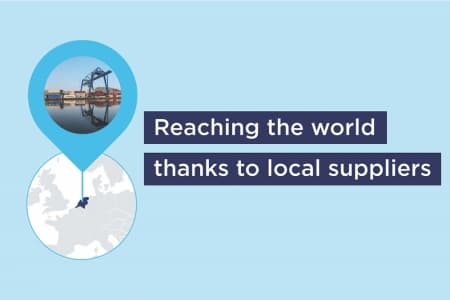
The power of local suppliers: more than shipping partners

The Van Berkel Group is located in Veghel, a town in the North Brabant region of the Netherlands. The company, founded in 1955 as a family company in agriculture, has expanded and diversified into many new sectors. In 2003, Van Berkel Logistics was established, with shipping services starting up in 2005, in the form of container transportation by barge from Veghel to Rotterdam and Antwerp. Read how Van Berkel managed to grow exponentially and leverage the power of exports by collaborating with Mars. 

News
23 Feb 2022
The power of local suppliers: more than shipping partners

Back then the company would ship 3000 containers per year. Fast forward to 2020, and that figure sits at 52 000 per year. The family company has grown to 210 employees across the whole group, with 90 employees dedicated to its logistics branch. Van Berkel’s collaboration with Mars began in 2013. Mars represents an important client for the logistics company, with orders for around 5000 container shipments per year. Of these, 60% are ‘deep sea’ shipments across the globe, versus 40% ‘short sea’ locations. However, Van Berkel’s partnership with Mars goes beyond simply shipping. Van Berkel is integrated into Mars factory proce, and the ‘make and ship’ principle ensures that whatever Mars produces can go directly into a container, which will be shipped on demand. Van Berkel’s service offering also encompasses quality control of containers. Thanks to Van Berkel’s logistics services, Mars products are able to reach consumers around the world who can enjoy the familiar taste of their renowned confectionery.

Acknowledgement: Michel van Dijk, Director, Van Berkel Logistics

The success story of global trade also lies in strong partnerships between companies of all sizes. Find out more about European ecosystems connecting small businesses with larger American companies. 

Related items

Position Paper
25 Sep 2026

Closing the gap between customs and VAT rules

The reform of the Union Customs Code changes who is treated as the ‘importer’ when a non-EU company uses an indirect customs representative. That creates a problem under the EU VAT Directive, which links import VAT deduction to being identified as the importer or consignee. In practice, the non-EU company may no longer meet that requirement, while the customs representative may not qualify for the deduction either.

That could leave import VAT irrecoverable and create uncertainty for businesses using established import models. The Commission should ensure that the non-EU principal can still be identified in customs data for VAT purposes and fix the mismatch between the UCC and the VAT Directive.

Learn more about what changes are needed to keep import VAT deductibility workable under the new customs framework.

Read more about Closing the gap between customs and VAT rules
Position Paper
24 Sep 2026

Gold-plating in practice

"Gold-plating" of EU legislation has become a structural challenge for companies operating across the Single Market. While Member States are often permitted to introduce additional national measures when implementing EU law, these divergences frequently create fragmented compliance requirements, administrative burdens and increased costs for businesses.

Drawing on examples from AmCham EU member companies across digital policy, cybersecurity, data protection, telecommunications, environmental regulation, consumer protection, tax transparency and labour law, the paper shows how national additions to EU rules can result in parallel compliance systems, duplicate reporting obligations, country-specific product adaptations and barriers to cross-border operations.

The paper highlights four key findings:

  • Divergence between Member States is often a bigger cost driver than any single regulatory requirement.

  • Fragmentation extends beyond directive transposition and also arises through opening clauses, national guidance, administrative practices and regional measures.

  • Minimum-harmonisation legislation can still create significant Single Market fragmentation.

  • Gold-plating occurs at both national and sub-national levels.

The European Commission should address these issues through greater consistency in implementation, increased transparency around national additions, reduced duplication in reporting and registration requirements, stronger implementation dialogue and the use of Single Market enforcement tools where appropriate. The objective is not to remove legitimate national discretion, but to prevent unnecessary regulatory barriers within the Single Market.

Simplification
Read more
Read more about Gold-plating in practice
News
23 Sep 2026

Europe in a new era of global competition

On Tuesday, 22 September, AmCham EU hosted Dragoș Tudorache, Member of the Cabinet of Executive Vice-President Stéphane Séjourné, European Commission, for a fireside chat. Moderated by Malte Lohan, CEO, AmCham EU, the conversation explored the growing role of economic security in Europe’s trade agenda and external relations. The exchange examined how this shift is shaping the EU’s engagement with trading partners and its position globally. Attention also turned to the choices facing Europe in a changing geo-strategic landscape, including how to reinforce resilience and strengthen competitiveness.

Industry
Simplification
Read more
Read more about Europe in a new era of global competition