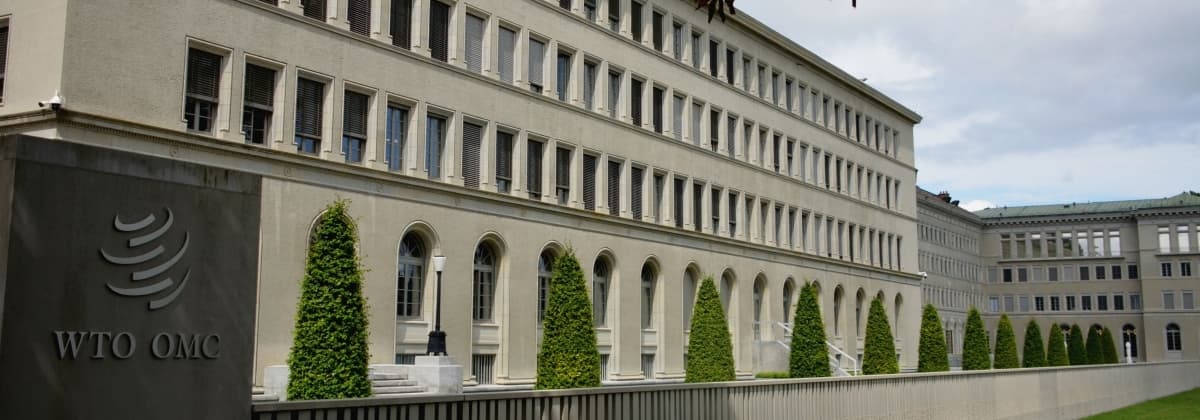
The Twelfth Ministerial Conference (MC12) of the World Trade Organization (WTO) concluded on Friday, 17 June 2022. The American Chamber of Commerce to the EU (AmCham EU) applauds the WTO and its Member States for reaching outcomes against a challenging geopolitical backdrop. Consensus was found on several issues, including food security, pandemic response, fishing subsidies, the moratorium on import duties for e-commerce and, most importantly, the reform of the WTO.
WTO ministerial: multilateralism remains critical but needs to deliver further results
The Twelfth Ministerial Conference (MC12) of the World Trade Organization (WTO) concluded on Friday, 17 June 2022. The American Chamber of Commerce to the EU (AmCham EU) applauds the WTO and its Member States for reaching outcomes against a challenging geopolitical backdrop. Consensus was found on several issues, including food security, pandemic response, fishing subsidies, the moratorium on import duties for e-commerce and, most importantly, the reform of the WTO.

While the agreements show the continued importance of the WTO in underpinning the rules-based international trading system, the outcomes also risk showing the limits of an unreformed institution. To that end, the commitment to reforming the WTO will be vital to follow through to meet the current needs of the global economy and to be better equipped to manage the future of international trade.
In regard to the decision to waive intellectual property rights on the COVID-19 vaccines, AmCham EU is concerned about the precedent this sets and questions whether the objectives of increasing access, improving distribution and promoting uptake around the world will be facilitated by this action. Weakening IP rules is not only unnecessary given the abundant global supply of vaccines, but will effectively weaken the ability to respond to future pandemics.
Looking ahead to future Ministerials and the organisation’s overall work, AmCham EU stands ready to work with the WTO and its Member States to build a more ambitious agenda, including commitments on issues such as tackling export restrictions and furthering digital trade.
Image credit: WTO (https://www.wto.org/english/res_e/photo_gallery_e/photo_gallery_e.htm)
Related items
:focal())
No further delays: the EU-Mercosur FTA is vital for a stronger Europe
The European Council’s decision to postpone its vote on concluding the EU-Mercosur free trade agreement (FTA) is a missed strategic opportunity that threatens the EU’s credibility as a reliable partner. After more than 20 years of negotiations, the EU is once again delaying one of its most ambitious and strategic trade agreements.
The EU-Mercosur FTA’s economic benefits are clear. At a time when strengthening competitiveness, economic growth and partnerships should be paramount, the FTA provides access to a market of 284 million consumers – reducing tariff and non-tariff barriers and supporting integrated supply chains.
Beyond its economic benefits, the EU-Mercosur FTA is also an important geopolitical tool. It would anchor a long-term strategic partnership with a key region and reinforce the EU’s role as a credible advocate of rules-based trade. Amid heightened geopolitical rivalry, postponement weakens the EU’s standing and its ability to conclude ambitious FTAs elsewhere.
The EU cannot afford further delays. The EU-Mercosur FTA is vital for the region’s competitiveness, resilience and global credibility. The European Council must promptly return to this file and conclude this FTA in January.
:focal())
Advocating for open, rules-based trade in Strasbourg
On Tuesday, 25 and Wednesday, 26 November 2025, AmCham EU travelled to the European Parliament in Strasbourg, France. Over the two-day programme, the delegation met with nearly a dozen MEPs and advisors for an exchange on the future of EU trade policy. Discussions centred on the importance of transatlantic cooperation, the ratification of the EU-Mercosur agreement and the implementation of the EU-US Framework Agreement. Members underlined the need for an ambitious EU trade agenda that ensures market access, reduces tariff and non-tariff barriers and strengthens the resilience of European industry. The delegation also called for a swift adoption of the Commission’s proposal on tariff reduction on US industrial goods and reiterated the importance of a pragmatic, forward-looking transatlantic agenda that promotes predictability and economic security.
:focal(610x264:611x265))
Examining where transatlantic trade goes from here with POLITICO
At the POLITICO Competitive Europe Summit, Malte Lohan, CEO, AmCham EU reiterated the need for swift implementation of the EU-US Framework Agreement and renewed its call for greater simplification of EU rules. Mr Lohan expressed cautious support for the deal, noting its role in avoiding damaging escalation and restoring a degree of predictability. He also underscored the importance of reducing regulatory burdens, highlighting simplification as a strategic priority for competitiveness. With the priority now on timely tariff reductions, regulatory cooperation and simplification, find out how our members see the deal evolving.
Mr Lohan was joined by Matthias Jørgensen, Head of Unit, USA and Canada, Directorate-General for Trade, European Commission and Jovita Neliupšienė, EU Ambassador to the US
Policy priorities
Insights and advocacy driving Europe’s policy agenda. Our priorities support growth, innovation and a stronger transatlantic economy.
Membership
Connecting business and policymakers to strengthen the voice of American companies in Europe.