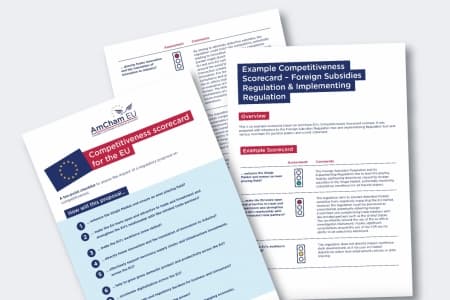
Competitiveness is a hot topic. But with Europe's attractiveness under threat, the EU needs to reset the agenda. Part of this is addressing how EU policy measures are made, as well as the substance of those proposals. To solve this, we have developed a Competitiveness Scorecard that features a simple yet effective ten-point checklist to evaluate new or revised regulations. By enhancing transparency, incorporating broad stakeholder insights and directly addressing key competitiveness factors, the Scorecard is a concrete way to significantly improve the quality and effectiveness of EU regulatory proposals. Learn more about the Competitiveness Scorecard in our latest blog.
Taking score of competitiveness in policymaking
Related items
:focal())
News
29 Sep 2026
Building trust without slowing innovation
At RAID 2026, Thibaut L’Ortye, Chief Policy and Public Affairs Officer, AmCham EU joined a panel discussion on EU-US regulatory approaches to technology. Taking place on Tuesday, 29 September 2026, the discussion explored how transatlantic cooperation can focus on shared outcomes rather than identical rulebooks, including on cybersecurity, AI safety, consumer protection and resilient supply chains. Mr L’Ortye also highlighted the wider conditions needed to strengthen Europe’s competitiveness.
:focal())
Position Paper
24 Sep 2026
Gold-plating in practice
"Gold-plating" of EU legislation has become a structural challenge for companies operating across the Single Market. While Member States are often permitted to introduce additional national measures when implementing EU law, these divergences frequently create fragmented compliance requirements, administrative burdens and increased costs for businesses.
Drawing on examples from AmCham EU member companies across digital policy, cybersecurity, data protection, telecommunications, environmental regulation, consumer protection, tax transparency and labour law, the paper shows how national additions to EU rules can result in parallel compliance systems, duplicate reporting obligations, country-specific product adaptations and barriers to cross-border operations.
The paper highlights four key findings:
Divergence between Member States is often a bigger cost driver than any single regulatory requirement.
Fragmentation extends beyond directive transposition and also arises through opening clauses, national guidance, administrative practices and regional measures.
Minimum-harmonisation legislation can still create significant Single Market fragmentation.
Gold-plating occurs at both national and sub-national levels.
The European Commission should address these issues through greater consistency in implementation, increased transparency around national additions, reduced duplication in reporting and registration requirements, stronger implementation dialogue and the use of Single Market enforcement tools where appropriate. The objective is not to remove legitimate national discretion, but to prevent unnecessary regulatory barriers within the Single Market.
:focal())
News
23 Sep 2026
Europe in a new era of global competition
On Tuesday, 22 September, AmCham EU hosted Dragoș Tudorache, Member of the Cabinet of Executive Vice-President Stéphane Séjourné, European Commission, for a fireside chat. Moderated by Malte Lohan, CEO, AmCham EU, the conversation explored the growing role of economic security in Europe’s trade agenda and external relations. The exchange examined how this shift is shaping the EU’s engagement with trading partners and its position globally. Attention also turned to the choices facing Europe in a changing geo-strategic landscape, including how to reinforce resilience and strengthen competitiveness.
Policy priorities
Insights and advocacy driving Europe’s policy agenda. Our priorities support growth, innovation and a stronger transatlantic economy.
Membership
Connecting business and policymakers to strengthen the voice of American companies in Europe.