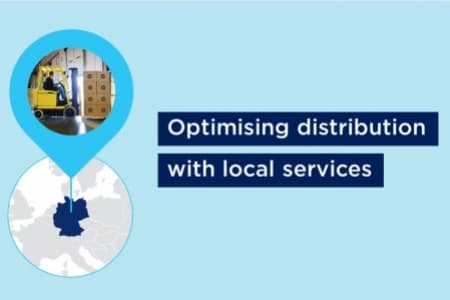
Optimising distribution with local services

HP Inc. is a multinational information technology company that develops personal computers, printers and 3D printing solutions. Distribution centres located in Germany serve as the epicentre of the company’s European operations, with finished products arriving from its international factories, ready for shipment. Read how HP Inc.'s parterships with local businesses encourage the development of innovative solutions to specific problems.

News
15 Mar 2022
Optimising distribution with local services

HP Inc. contracts three distribution partners in Germany. Among these, one is a local distribution company, by the name of LGI. LGI has been working with HP Inc. for 20 years, since it was founded as a spin-off from the company itself. Originally, HP Inc. was LGI’s only customer, but nowadays the company accounts for 20% of LGI’s custom. LGI employs 300-500 people for HP Inc.-related activity. They run one of HP Inc.’s German distribution centres – operating the warehouse, providing storage solutions, packaging products, loading them into trucks and shipping them to their destination. LGI also manages inventory and returns on behalf of HP Inc.

For local suppliers, working with HP Inc. is advantageous because it provides an opportunity to find innovative solutions to specific problems. Smaller local suppliers are often more capable of providing niche services than global competitors. For example, in order to manage its logistics activity, HP Inc. enlisted the services of a local partner, which was able to offer HP Inc. a specific optimisation tool to match its particular needs. The service offering was customised to HP Inc.’s use-case to such a degree that no other global supplier on the market could rival the service.

Thanks to local suppliers, HP Inc. benefits from flexibility gains. By outsourcing, the company can reduce sunk costs in warehousing infrastructure and resources. HP Inc. can therefore focus its resources on its core competency of producing its bestin-class technology hardware.

Acknowledgement: Volker Schmitz, Global Head of Markets Supply Chain Operations


The success story of global trade lies in strong partnerships between companies of all sizes. Find out more about European ecosystems connecting small businesses with larger American companies. 

Related items

News
30 Jun 2026

Advancing skills for Europe’s AI transition

On Tuesday, 30 June, AmCham EU hosted a roundtable exploring strategies for preparing Europe’s workforce for the age of artificial intelligence (AI). Members and policymakers analysed how AI is changing roles across sectors and how employers, governments and education providers can respond. Joined by Idoia Mendia, MEP (ES, S&D) and Mario Nava, Director-General, Directorate-General for Employment, Social Affairs and Inclusion, European Commission, the conversation focused on digital and data skills, as well as expanding AI literacy across organisations. Participants also discussed reskilling and public-private cooperation to support a more inclusive labour market. In addition, members shared best practices from their companies and pointed to the need for policy frameworks that support lifelong learning and skills-based hiring. As AI becomes part of everyday work, Europe must close the skills gap to strengthen competitiveness and prepare people for the future of work.

Social impact, inclusion and skills
Read more
Read more about Advancing skills for Europe’s AI transition
Position Paper
30 Jun 2026

Understanding the first public country-by-country reports

Tuesday, 30 June 2026 marks an important milestone in the implementation of the EU public Country-by-Country Reporting (pCbCR) Directive. For the first time, many multinational enterprises with a 30 June financial year-end will be required to publish information under the Directive.

As stakeholders and policymakers begin to analyse and interpret the newly available data, it is important that they interpret it within the context of the specific reporting rules defined by the EU Directive.

The pCbCR Directive stands apart from reporting done for tax purposes and its fragmented implementation has created significant complexities for taxpayers.

Read more about how lawmakers should approach this first round of reports and why pCbCR simplification is vital to support tax transparency and reporting efficiency.

Read more about Understanding the first public country-by-country reports
News
29 Jun 2026

Ukraine Recovery Conference 2026: highlighting the importance of transatlantic cooperation

From Thursday, 25 to Friday, 26 June 2026, AmCham EU participated in the Ukraine Recovery Conference in Gdańsk, Poland, engaging in discussions on reconstruction, economic recovery and Ukraine’s path toward EU integration. The conference took place amid renewed optimism following the opening of the Fundamentals Cluster in Ukraine’s accession negotiations, an important step in the country’s continued alignment with the EU acquis. Discussions underlined the importance of rule of law and anti-corruption reforms in creating a predictable investment environment. They also highlighted the role of private sector investment and the need for sustained transatlantic cooperation to support Ukraine’s long-term recovery. Learn more about the steps Ukraine is taking to strengthen the rule of law build investor confidence.

Ukraine
Read more
Read more about Ukraine Recovery Conference 2026: highlighting the importance of transatlantic cooperation