MC12: the ingredients to make it a success

After being postponed last December due to rising COVID-19 rates, the twelfth Ministerial Conference of the WTO will take place in Geneva between 12-15 June. The Ministerial will take place under challenging and divisive circumstances, including the remaining effects of the COVID pandemic and the devastation caused by the war in Ukraine. These and other issues will make it difficult for the Ministerial to make progress towards an agreed common statement. Regardless, as US business in Europe, we emphasise the importance of the WTO as a pillar of the rules-based multilateral trading system and a stabiliser and unifier for international trade.

News
12 Jun 2022
Trade
MC12: the ingredients to make it a success

After being postponed last December due to rising COVID-19 rates, the twelfth Ministerial Conference of the WTO will take place in Geneva between 12-15 June. The Ministerial will take place under challenging and divisive circumstances, including the remaining effects of the COVID pandemic and the devastation caused by the war in Ukraine. These and other issues will make it difficult for the Ministerial to make progress towards an agreed common statement. Regardless, as US business in Europe, we emphasise the importance of the WTO as a pillar of the rules-based multilateral trading system and a stabiliser and unifier for international trade.

The WTO has undoubtedly helped open up international markets and raise global standards. For instance, between 1995 and 2011 alone, more than 400 trade disputes were brought to the WTO, which on average took only ten months to resolve in panel proceedings. Negotiations and agreements like these have allowed trade to open and flow more freely, which, in turn, has boosted annual incomes and provided a wider range of goods and services available to consumers. Its role as a guarantor of a rules-based trade system for governments, companies and consumers, is indispensable.

Despite the difficulties that the currently WTO faces, it is clear that it can aim for tangible achievements, specially in events like the upcoming Ministerial. In this regard, AmCham EU urges for action on key areas. 

The first priority should be renewing of the Moratorium on Customs Duties on Electronic Transmissions, so that it can ideally become permanent in the future. Since 1988, ministerial conferences have consistently renewed this moratorium, which prevents tariffs from being placed on electronic transmissions. Failing to renew it at MC12 would represent an unprecedented lapse in capacity for the WTO. The inclusion of tariffs on electronic transmissions would also raise prices, hinder consumption, slow economic growth and further diminish WTO leadership at a critical time.

The second priority should be to address the concrete challenges of vaccine distribution. The latest data shows that the production of vaccines outpaces the rate at which they are being administered. The focus now should be on overcoming the practical difficulties of vaccine coordination and handling vaccines and vaccine hesitancy, which limit their uptake. Last year, Susan Danger, CEO, AmCham EU said  ‘An IP waiver will not improve the distribution of vaccines to citizens around the world’.

Lastly, the WTO must undergo reforms that will make it fit for the 21st century. Reform is an issue that AmCham EU had also called for before the postponement of MC12 last year. The importance of the WTO’s capacity to provide a forum for negotiation, its role as a monitor of the rules-based trading environment and the need for it to act as a pillar of the multilateral trading system cannot be understated. The EU and US must take leadership at this Ministerial and beyond to strengthen the monitoring role of the WTO secretariat, revitalize the negotiating function and restore the Appellate Body to functioning order.

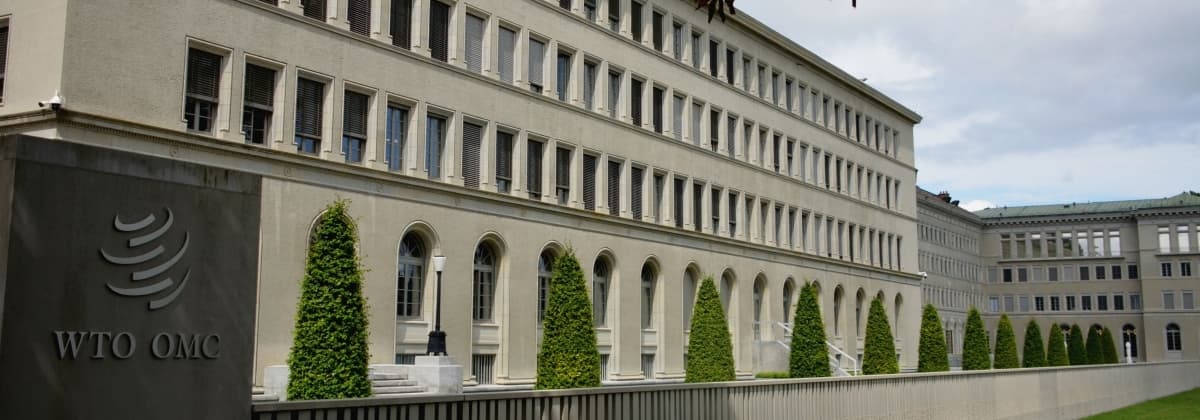
Image credit: WTO (https://www.wto.org/english/res_e/photo_gallery_e/photo_gallery_e.htm

Related items

News
22 Dec 2025

No further delays: the EU-Mercosur FTA is vital for a stronger Europe

The European Council’s decision to postpone its vote on concluding the EU-Mercosur free trade agreement (FTA) is a missed strategic opportunity that threatens the EU’s credibility as a reliable partner. After more than 20 years of negotiations, the EU is once again delaying one of its most ambitious and strategic trade agreements.

The EU-Mercosur FTA’s economic benefits are clear. At a time when strengthening competitiveness, economic growth and partnerships should be paramount, the FTA provides access to a market of 284 million consumers – reducing tariff and non-tariff barriers and supporting integrated supply chains.

Beyond its economic benefits, the EU-Mercosur FTA is also an important geopolitical tool. It would anchor a long-term strategic partnership with a key region and reinforce the EU’s role as a credible advocate of rules-based trade. Amid heightened geopolitical rivalry, postponement weakens the EU’s standing and its ability to conclude ambitious FTAs elsewhere.

The EU cannot afford further delays. The EU-Mercosur FTA is vital for the region’s competitiveness, resilience and global credibility. The European Council must promptly return to this file and conclude this FTA in January.

Read more about No further delays: the EU-Mercosur FTA is vital for a stronger Europe
News
27 Nov 2025

Advocating for open, rules-based trade in Strasbourg

On Tuesday, 25 and Wednesday, 26 November 2025, AmCham EU travelled to the European Parliament in Strasbourg, France. Over the two-day programme, the delegation met with nearly a dozen MEPs and advisors for an exchange on the future of EU trade policy. Discussions centred on the importance of transatlantic cooperation, the ratification of the EU-Mercosur agreement and the implementation of the EU-US Framework Agreement. Members underlined the need for an ambitious EU trade agenda that ensures market access, reduces tariff and non-tariff barriers and strengthens the resilience of European industry. The delegation also called for a swift adoption of the Commission’s proposal on tariff reduction on US industrial goods and reiterated the importance of a pragmatic, forward-looking transatlantic agenda that promotes predictability and economic security.

Read more about Advocating for open, rules-based trade in Strasbourg
News
1 Oct 2025

Examining where transatlantic trade goes from here with POLITICO

At the POLITICO Competitive Europe Summit, Malte Lohan, CEO, AmCham EU reiterated the need for swift implementation of the EU-US Framework Agreement and renewed its call for greater simplification of EU rules. Mr Lohan expressed cautious support for the deal, noting its role in avoiding damaging escalation and restoring a degree of predictability. He also underscored the importance of reducing regulatory burdens, highlighting simplification as a strategic priority for competitiveness. With the priority now on timely tariff reductions, regulatory cooperation and simplification, find out how our members see the deal evolving

Mr Lohan was joined by Matthias Jørgensen, Head of Unit, USA and Canada, Directorate-General for Trade, European Commission and Jovita Neliupšienė, EU Ambassador to the US 

Trade
Transatlantic
Read more
Read more about Examining where transatlantic trade goes from here with POLITICO