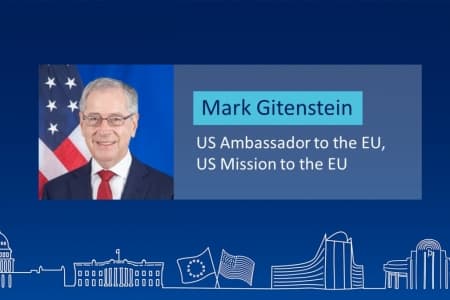
Invitation to lunch with The Hon Mark Gitenstein, US Ambassador to the EU
As the invasion of Ukraine unfolds, the importance of a strong transatlantic relationship is clear. Upholding human rights, protecting democracy and respecting the rule of law are values shared not only by the transatlantic partners, but also by many other international actors. This Transatlantic Conference, don't miss out on the opportunity to hear from a wide range of international leaders including a discussion over lunch with Mark Gitenstein, US Ambassador to the EU, who will share about the priorities that are high on his list as well as the ways US and EU policymakers can align their goals to leverage their joint impact. Registrations for the conference including the lunch session (for members and non-members) are available here.
Related items
:focal())
Closing the gap between customs and VAT rules
The reform of the Union Customs Code changes who is treated as the ‘importer’ when a non-EU company uses an indirect customs representative. That creates a problem under the EU VAT Directive, which links import VAT deduction to being identified as the importer or consignee. In practice, the non-EU company may no longer meet that requirement, while the customs representative may not qualify for the deduction either.
That could leave import VAT irrecoverable and create uncertainty for businesses using established import models. The Commission should ensure that the non-EU principal can still be identified in customs data for VAT purposes and fix the mismatch between the UCC and the VAT Directive.
Learn more about what changes are needed to keep import VAT deductibility workable under the new customs framework.
:focal())
Gold-plating in practice
"Gold-plating" of EU legislation has become a structural challenge for companies operating across the Single Market. While Member States are often permitted to introduce additional national measures when implementing EU law, these divergences frequently create fragmented compliance requirements, administrative burdens and increased costs for businesses.
Drawing on examples from AmCham EU member companies across digital policy, cybersecurity, data protection, telecommunications, environmental regulation, consumer protection, tax transparency and labour law, the paper shows how national additions to EU rules can result in parallel compliance systems, duplicate reporting obligations, country-specific product adaptations and barriers to cross-border operations.
The paper highlights four key findings:
Divergence between Member States is often a bigger cost driver than any single regulatory requirement.
Fragmentation extends beyond directive transposition and also arises through opening clauses, national guidance, administrative practices and regional measures.
Minimum-harmonisation legislation can still create significant Single Market fragmentation.
Gold-plating occurs at both national and sub-national levels.
The European Commission should address these issues through greater consistency in implementation, increased transparency around national additions, reduced duplication in reporting and registration requirements, stronger implementation dialogue and the use of Single Market enforcement tools where appropriate. The objective is not to remove legitimate national discretion, but to prevent unnecessary regulatory barriers within the Single Market.
:focal())
Europe in a new era of global competition
On Tuesday, 22 September, AmCham EU hosted Dragoș Tudorache, Member of the Cabinet of Executive Vice-President Stéphane Séjourné, European Commission, for a fireside chat. Moderated by Malte Lohan, CEO, AmCham EU, the conversation explored the growing role of economic security in Europe’s trade agenda and external relations. The exchange examined how this shift is shaping the EU’s engagement with trading partners and its position globally. Attention also turned to the choices facing Europe in a changing geo-strategic landscape, including how to reinforce resilience and strengthen competitiveness.
Policy priorities
Insights and advocacy driving Europe’s policy agenda. Our priorities support growth, innovation and a stronger transatlantic economy.
Membership
Connecting business and policymakers to strengthen the voice of American companies in Europe.