Fostering innovation through collaborative partnerships

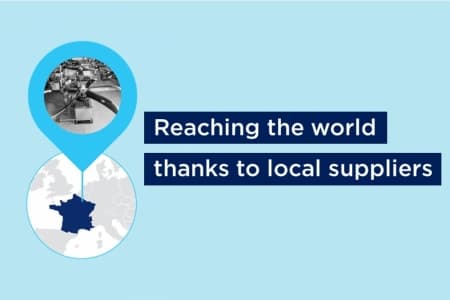
Despite only having 10,000 inhabitants, Figeac in south-west France is home to a whole ecosystem of aerospace companies and suppliers. Collins Aerospace, a Raytheon Technologies company, is one of them. Its Ratier-Figeac unit is an internationally renowned centre of excellence for propellers. Collins Aerospace RatierFigeac employs 1,200 people in four key business segments. Its main undertaking is propellers, which account for about 60% of the Ratier-Figeac unit’s activities. 60% of its total global expenditure on local suppliers is in France. Discover their success story.

News
27 Feb 2022
Fostering innovation through collaborative partnerships

Collins Aerospace Ratier-Figeac calls on hundreds of local suppliers in the French market. Their overall reactivity; their geographic proximity; and their agile and innovative dynamic are all valued assets for Collins Aerospace. By working with suppliers, Collins Aerospace support an estimated 600 jobs in France on top of its direct employees.

A specific example of an outsourced service is propeller painting. Collins Aerospace Ratier-Figeac contracts the services of two local suppliers to perform the finishing and painting of their propeller blades within a lead time of 3 days. Traditionally competitors, the two companies have recently teamed up to collaborate on a technological innovation in their sandblasting processes before painting the blades. They have partnered up to automatise the process of sandblasting, adding even greater quality and efficiency to their collective service. For local suppliers such as the paint shops in Figeac, working with Collins Aerospace is a great opportunity: It is a well-known brand, with a focus on producing the highest quality. As the example of the paint shops attests, Collins Aerospace provides support to local suppliers to achieve the levels of service demanded. In turn, Collins Aerospace counts on its suppliers to deliver its reputed equipment.

*A Raytheon Technologies company
Acknowledgement: Patrick Derbois, Director of Supply Chains, Collins Propeller Systems

The success story of global trade lies in strong partnerships between companies of all sizes. Find out more about European ecosystems connecting small businesses with larger American companies. 

Related items

Position Paper
20 Jul 2026

Principles for economically efficient and growth-compatible tax reform in the EU

The Draghi report highlights how economic growth has stagnated in the EU due to structural weaknesses that risk undermining the EU’s global competitiveness. To bolster the EU’s attractiveness and competitiveness, lawmakers should pursue a coherent pro-growth tax reform agenda. A pro-growth tax reform agenda in the EU27 can be evaluated through five principles: (a) economic efficiency, including low distortion of economic decisions and low administrative and compliance costs; (b) consideration and strong discipline across the entire lifecycle of tax policy reform: initial decision making process, legal design and implementation; (c) evidence-based accountability through clear objectives, rigorous impact assessment, meaningful consultation and ex post review; (d) strengthening the Single Market rather than adding cross-border frictions; and (e) neutrality and fair competitive conditions across sectors, countries and business models.

These principles are mutually reinforcing: growth is supported not only by sound and coherent statutory design, but by the full tax system including law, administration and taxpayer interaction. AmCham EU has prepared a framework for EU lawmakers to use while designing, implementing and evaluating tax policy based upon our members’ experiences operating in every EU Member State and almost every country around the world.

Read more about Principles for economically efficient and growth-compatible tax reform in the EU
Blog
20 Jul 2026

Tax policy may not always make headlines – but its benefits certainly are

Tax
Simplification
Read more
Read more about Tax policy may not always make headlines – but its benefits certainly are
Position Paper
20 Jul 2026

Sustainable Finance Disclosure Regulation 2.0: getting the architecture right

The EU’s sustainable finance rules should help investors understand where their money is going and support Europe’s transition. The Commission’s proposal improves the current system, but some changes are still needed.

The new Transition category should focus on whether companies are cutting emissions, not on the sector they operate in. The 70% threshold should stay. The rules should also work with MiFID II and the EU Taxonomy.

Companies need 24 months to prepare. Firms that fall outside the new scope should stop reporting as soon as the rules enter into force.

Read the paper to learn how SFDR 2.0 can direct more capital towards Europe’s transition.

Financial services
Read more
Read more about Sustainable Finance Disclosure Regulation 2.0: getting the architecture right