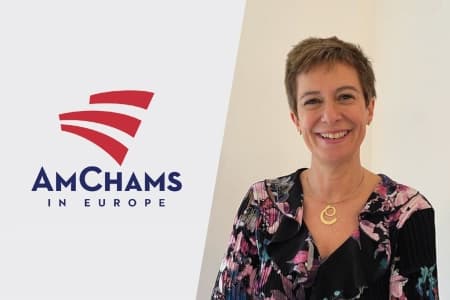
AmCham EU CEO Susan Danger re-elected as Chairwoman of the AmChams in Europe network

Susan Danger, CEO, American Chamber of Commerce to the EU (AmCham EU), has been re-elected as Chairwoman of the AmChams in Europe network. She will serve for a second two-year term leading the Executive Committee of the umbrella organisation for 46 American Chambers of Commerce from 44 countries throughout Europe and Eurasia. AmChams in Europe represents the interests of more than 17,000 American and European companies employing 20 million workers.

News
13 Dec 2021
AmCham EU CEO Susan Danger re-elected as Chairwoman of the AmChams in Europe network

In her role as Chairwoman of AmChams in Europe, Ms Danger aims to continue to engage and speak out on the need for a strong global economic recovery and the importance of the transatlantic partnership. Building on over two decades of experience, she will strive to further strengthen collaboration between European and transatlantic partners at a time where bringing business, government and civil society together has never been more important.

Susan Danger, CEO, AmCham EU and Chairwoman, AmChams in Europe said: ‘I am truly honoured to serve another term as Chair of this amazing network. I aim to continue to contribute to bringing the voice of the transatlantic business community to an even wider audience on issues such as the digital and green transitions, the transatlantic economy, diversity, equity and inclusion (DEI) as well as the future of work.’ She added: ‘I believe in the positive impact our Chambers make by fostering conversations between diverse groups of stakeholders and playing a critical role in building bridges across the whole of Europe but also across the Atlantic. It is also about teamwork more than anything. I value the energy, creativity and optimism that comes from the strong partnership with the AmChams in Europe secretariat lead by Ajsa Vodnik, CEO, AmCham Slovenia, and the collaboration with my other AmCham colleagues’.

Related items

News
7 Jul 2026

Branching out with AI

Meta’s open-source Canopy Height Maps helped the European Commission’s Joint Research Centre improve its 2020 Global Forest Cover map, demonstrating how artificial intelligence can strengthen Europe’s ability to monitor forests and advance climate and biodiversity goals. Developed with the World Resources Institute, the maps use Meta’s DINO self-supervised computer vision model to estimate tree height from satellite imagery. This helped researchers apply the five-metre threshold used in many international forest definitions and better distinguish forests from other tree-covered land, including agricultural tree crops. The resulting product, available through the EU Forest Observatory, provides one of the most comprehensive open views of global forest cover. Read more on Invested in Europe.

Digital
Read more
Read more about Branching out with AI
Blog
3 Jul 2026

The transatlantic relationship at 250 years: a shared history and a forged future

Authored by Malte Lohan, CEO, AmCham EU

Transatlantic
Read more
Read more about The transatlantic relationship at 250 years: a shared history and a forged future
News
3 Jul 2026

Advancing skills for Europe’s AI transition

On Tuesday, 30 June, AmCham EU hosted a roundtable exploring strategies for preparing Europe’s workforce for the age of artificial intelligence (AI). Members and policymakers analysed how AI is changing roles across sectors and how employers, governments and education providers can respond. Joined by Idoia Mendia, MEP (ES, S&D) and Mario Nava, Director-General, Directorate-General for Employment, Social Affairs and Inclusion, European Commission, the conversation focused on digital and data skills, as well as expanding AI literacy across organisations. Participants also discussed reskilling and public-private cooperation to support a more inclusive labour market. In addition, members shared best practices from their companies and pointed to the need for policy frameworks that support lifelong learning and skills-based hiring. As AI becomes part of everyday work, Europe must close the skills gap to strengthen competitiveness and prepare people for the future of work.

Social impact, inclusion and skills
Read more
Read more about Advancing skills for Europe’s AI transition