Aligning with industry to increase Europe's defence
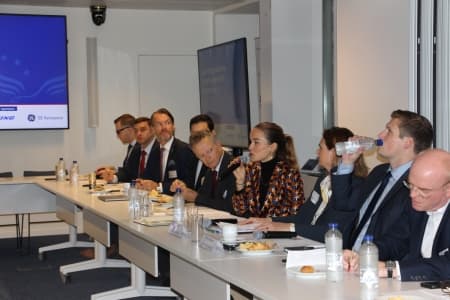
On Thursday, 12 October, AmCham EU held a roundtable breakfast to discuss the importance of strengthening the EU's defence industry with representatives from the defence sector. Representatives and AmCham EU members took part in an open discussion that was moderated by Lucia López Carasa, Policy Adviser, AmCham EU. From the roundtable, it was clear that the priority should be on remaining open to cooperation with likeminded countries, investing in boosting Europe’s attractiveness and working with American industry to meet the EU's defence capabilities.
Related items
:focal())
A strong Europe benefits partners around the world
In her 2026 State of the Union address, European Commission President Ursula von der Leyen described ‘a complex age of great possibilities and great perils’. From geopolitical tensions and energy prices to supply chain disruption, businesses operating in Europe face this reality every day. It is an environment that underscores the need for a strong Europe. A stronger, more united Europe is a more attractive place for American companies to invest.
:focal())
Welcoming Brussels back to business
On Wednesday, 9 September, AmCham EU joined 19 other associations to mark Brussels’ return from the summer break at the Royal Belgian Institute of Natural Sciences. The event drew over 800 guests and included a keynote speech by Jessika Roswall, European Commissioner for Environment, Water Resilience and a Competitive Circular Economy. The evening provided a platform for stakeholders from industry, politics, civil society and media to connect. This year’s conversations focused on Europe’s place in a changing world and the policies needed to boost growth and the EU’s competitiveness.
:focal())
Public Procurement Act: an ambitious step forward for simplified procurement in the EU
The European Commission’s new Public Procurement Act (PPA) proposal is a positive step for procurement in the EU. It would support Europe’s competitiveness by allowing governments and public authorities to access best-in-class products. Similarly, it would simplify procurement through consistent auction design and digitalisation, leading to greater transparency and document reuse. Together, these reforms would help governments invest public revenues in innovative solutions, while tearing down the barriers that keep companies of all sizes from accessing public procurement markets in Europe.
International companies bring significant value to the EU’s public procurement markets. The PPA would allow them to continue contributing to the EU through a clear framework for Made in Europe built around the EU’s public procurement agreements. Undermining these commitments or creating excessive compliance costs would decrease the EU’s access to best-in-class solutions and take limited resources away from the PPA’s other improvements. The current proposal would further the EU's economic security agenda without closing off procurement markets to trusted partners. The PPA can succeed if it creates a simple and quality-driven system that supports the EU’s competitiveness agenda.
Policy priorities
Insights and advocacy driving Europe’s policy agenda. Our priorities support growth, innovation and a stronger transatlantic economy.
Membership
Connecting business and policymakers to strengthen the voice of American companies in Europe.