On Tuesday, 4 October AmCham EU hosted a lunch with Dan Hamilton, Senior Fellow, Johns Hopkins University SAIS Foreign Policy Institute and author of the Transatlantic Economy Study, AmCham EU's annual publication on the facts and figures of the world's largest economic relationship. During the session, he shared his perspectives on the war in Ukraine, the Trade and Technology Council and key policy issues to the EU-US trading relationship including energy, data flows and nonmarket economies. While we face serious challenges, the EU and US are inextricably linked, and stronger together.
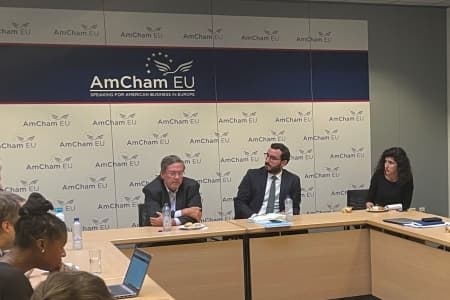
Transatlantic economy working lunch
On Tuesday, 4 October AmCham EU hosted a lunch with Dan Hamilton, Senior Fellow, Johns Hopkins University SAIS Foreign Policy Institute and author of the Transatlantic Economy Study, AmCham EU's annual publication on the facts and figures of the world's largest economic relationship. During the session, he shared his perspectives on the war in Ukraine, the Trade and Technology Council and key policy issues to the EU-US trading relationship including energy, data flows and nonmarket economies. While we face serious challenges, the EU and US are inextricably linked, and stronger together.

Related items
:focal())
EU-Mercosur vote: a self-inflicted setback to Europe's strategic interests
The European Parliament’s decision to refer the EU-Mercosur free trade agreement (FTA) to the Court of Justice adds a further delay to one of the EU’s most important and long-running trade initiatives.
Commenting on the vote, Malte Lohan, CEO of AmCham EU, said: ‘Today’s vote by the European Parliament to refer the EU-Mercosur agreement to the Court of Justice is a self-inflicted setback for Europe’s economic interests and geopolitical relevance at a moment when the EU can least afford it.
After 25 years of negotiations, this should have been Europe stepping forward as a global trade leader and champion of win-win partnerships. It was an opportunity to strengthen Europe’s global position, diversify supply chains and open new opportunities in a fast-growing market of 284 million people.
Instead, this vote has chosen - yet again - delay.
Europe’s credibility as a trade powerhouse is now on the line. The EU must move decisively to get this agreement back on track.’
The EU-Mercosur FTA will deepen economic ties, reduce barriers to trade and strengthen long-term engagement with a key region. How this process now unfolds will be critical not only for the agreement itself, but also for confidence in the EU’s broader trade agenda.
EU-US: further escalation would threaten economy, security
The American Chamber of Commerce to the EU (AmCham EU) is concerned about recent developments that may fundamentally undermine the EU-US Framework Agreement and lead to tit-for-tat measures that will hurt American and European companies. If the dispute escalates, it could quickly spread across large parts of the economy, with far-reaching knock-on effects. It would cause severe damage to economic welfare and security on both sides. A negotiated outcome must urgently be found.
The rules-based international system brings certainty and stability to business relations around the world to the benefit of all companies operating across borders. When the time is right, both sides should seek to return to the spirit of the EU-US Framework Agreement, as the best available way to safeguard the EUR 8.7 trillion transatlantic economy.
:focal())
European business associations celebrate the signature of EU-Mercosur FTA
Today marks a historic milestone with the signing of the EU-Mercosur Trade Agreement, creating the biggest trading block in the world. European business – represented by more than 28 associations across a wide range of sectors – warmly welcomes this signature. It sends a strong and timely signal that the EU remains open and is committed to rules-based global trade. In a time of global uncertainty, this agreement is a key growth booster.
By opening access to over 270 million consumers via the elimination of trade barriers and the removal of tariffs on over 90% of EU exports, the agreement provides the thrust European companies need to export, invest, and grow, as well as to diversify their supply chains, sourcing essential products and raw materials from Mercosur. By 2040, according to DG Trade’s calculations, the agreement is expected to add 77.6 billion euros to the EU GDP, resulting in a 39% increase in EU exports to Mercosur.
With the agreement now signed, the ball is firmly in the court of the European Parliament in ensuring rapid ratification. We therefore call on Members of the European Parliament to give their consent and allow Europe’s engine of economic growth and prosperity to be switched on and move ahead decisively. After over 25 years of negotiations, we are finally in sight of the finish line. We cannot afford to wait any longer.
Policy priorities
Insights and advocacy driving Europe’s policy agenda. Our priorities support growth, innovation and a stronger transatlantic economy.
Membership
Connecting business and policymakers to strengthen the voice of American companies in Europe.