Transatlantic Conference 2021: in review

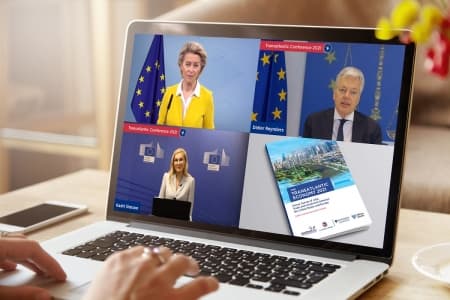
This year’s Transatlantic Week, set against the need to rebuild a world economy devastated by the impact of COVID-19 and to ensure future healthy, connected and sustainable societies, was themed ‘Global leadership: A transatlantic opportunity’. The activities of the week opened on Wednesday, 24 March for the first time entirely digitised with a keynote by European Commission President Ursula von der Leyen.

News
29 Mar 2021
Transatlantic
Transatlantic Conference 2021: in review

This year’s Transatlantic Week, set against the need to rebuild a world economy devastated by the impact of COVID-19 and to ensure future healthy, connected and sustainable societies, was themed ‘Global leadership: A transatlantic opportunity’. The activities of the week opened on Wednesday, 24 March for the first time entirely digitised with a keynote by European Commission President Ursula von der Leyen.

President von der Leyen stressed that the two sides of the Atlantic are once again speaking the same language, of cooperation in international affairs and underscored that now is ‘time for the Atlantic to once again become the beating heart of global cooperation’. You can read the entire transcript of President von der Leyen’s speech on the European Commission website.

The first day of the conference served as the launching point for the Transatlantic Economy 2021 report, done in partnership with the U.S. Chamber of Commerce, which includes the latest facts and figures about the EU-US economic relationship. This year’s edition features insights into the impact of the COVID-19 pandemic, prospects for the economic recovery, Brexit, relations with China and the transatlantic energy economy. Research for the report was conducted by Daniel Hamilton and Joseph Quinlan for the Wilson Center’s Global Europe Program and the Foreign Policy Institute at Johns Hopkins University’s School of Advanced International Studies. You can learn more about the speakers and sessions in our day one summary article.

On the second day of the conference, there was a shift in focus from trade to climate and sustainability. European Commissioner for Energy Kadri Simson delivered the opening keynote speech, reaffirming that climate change is a priority for the EU and expressed her satisfaction that the US is ‘back in the game’ in reference to the Biden administration re-joining the Paris Agreement. The full speech is available on the European Commission website, and the full write up on day two speakers and discussions can be found in our day two summary article.

Finally, on the third day of the conference the focused shifted towards the digital economy, featuring a keynote from European Commissioner for Justice Didier Reynders. In his keynote, he pointed to the joint commitment he and US Secretary of Commerce Gina Raimondo made a day prior to accelerate efforts to develop a new Privacy Shield. He underscored that there is still more that binds the EU and the US together than divides us; and he called for common approaches to solve the challenges of our time. His full speech is also available on the European Commission website. Meanwhile, you can find all the details on the speakers and discussions in our day three summary article.

With thanks to our media partner, Euronews, and our sponsors, Google, Lilly, 3M, Goodyear, Interdigital, Procter & Gamble, Workday and IBM.

Related items

News
23 Jan 2026

Keeping the implementation of the EU-US deal on course

Ahead of the Committee on International Trade’s (INTA) meeting in the European Parliament on Monday, 26 January 2026, AmCham EU reiterates its call to advance the Commission’s tariff reduction proposals as part of the wider EU-US Framework Agreement. We understand MEPs’ caution following a week of renewed transatlantic tensions, but do not see the tariff reduction proposals as the right avenue for addressing these issues. The Framework Agreement remains the best available option for securing a more positive, productive EU-US trade and investment climate that helps businesses plan ahead.  

As part of the Agreement, the EU and the US made a range of initial commitments. Last September, the US took its first step by updating its tariff schedule on EU products. The two tariff reduction proposals are how the EU shows its commitment to follow suit. This is just the start of the longer-term process of implementing the deal. Later, there will be opportunities to address other issues important to businesses on both sides of the Atlantic. A functioning EU-US economic relationship is critical to millions of American and European businesses and livelihoods.  

Transatlantic
Read more
Read more about Keeping the implementation of the EU-US deal on course
News
19 Jan 2026

EU-US: further escalation would threaten economy, security

The American Chamber of Commerce to the EU (AmCham EU) is concerned about recent developments that may fundamentally undermine the EU-US Framework Agreement and lead to tit-for-tat measures that will hurt American and European companies. If the dispute escalates, it could quickly spread across large parts of the economy, with far-reaching knock-on effects. It would cause severe damage to economic welfare and security on both sides. A negotiated outcome must urgently be found.

The rules-based international system brings certainty and stability to business relations around the world to the benefit of all companies operating across borders. When the time is right, both sides should seek to return to the spirit of the EU-US Framework Agreement, as the best available way to safeguard the EUR 8.7 trillion transatlantic economy.

Trade tensions
Transatlantic
Read more
Read more about EU-US: further escalation would threaten economy, security
News
11 Dec 2025

Exploring transatlantic ties at AmCham Luxembourg

On Tuesday 2 December, Thibaut L’Ortye, Senior Director of Public Affairs, AmCham EU presented The Transatlantic Economy 2025 report at AmCham Luxembourg’s Transatlantic Trade and Investment event. Stacey Feinberg, US Ambassador to Luxembourg highlighted the strong ties between Luxembourg and the US, with over 150,000 people employed thanks to the partnership. During his section, Mr L’Ortye presented the results of the report, with a particular focus on the resiliency of the EU-US relationship. Despite differing views on certain issues, the transatlantic partnership remains the most integrated in the world, directly responsible for 16 million jobs and one third of global GDP.

Transatlantic
Read more
Read more about Exploring transatlantic ties at AmCham Luxembourg