Transatlantic 2023: in review

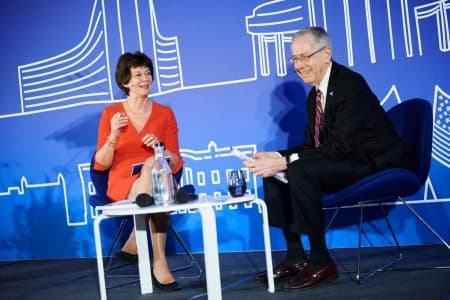
This year’s Transatlantic Conference, ‘Thriving together: uniting in the face of global challenges’ put industry and institutions in the same room to discuss the importance of a strong and united transatlantic relationship, especially on the green and digital transitions. The conference took place on Wednesday, 22 March 2023 and featured speakers from both sides of the Atlantic. As an opening video, Gina Raimondo, US Secretary of Commerce, underlined the importance of keeping the transatlantic dialogue open through forums like the Trade and Technology Council. Michael Miebach, CEO, Mastercard, then expanded on why the focus should be on innovation, sustainability and inclusion to keep the EU and US competitive.  

News
22 Mar 2023
Transatlantic 2023: in review

This year’s Transatlantic Conference, ‘Thriving together: uniting in the face of global challenges’ put industry and institutions in the same room to discuss the importance of a strong and united transatlantic relationship, especially on the green and digital transitions. The conference took place on Wednesday, 22 March 2023 and featured speakers from both sides of the Atlantic. As an opening video, Gina Raimondo, US Secretary of Commerce, underlined the importance of keeping the transatlantic dialogue open through forums like the Trade and Technology Council. Michael Miebach, CEO, Mastercard, then expanded on why the focus should be on innovation, sustainability and inclusion to keep the EU and US competitive.  

The conference included a series of panel discussions, diving into key priorities for the transatlantic relationship. First off was a conversation focused on how the EU and the US can navigate the difficult external environment. The panellists focused on transatlantic cooperation and the need to collaborate with industry in addressing shared issues. Afterwards, the conversation turned to the transatlantic economy. The speakers explained how to continue economic growth, the EU and US have to find global solutions to shared challenges.  

Following the initial panel discussions, Daniel Hamilton and Joseph Quinlan presented the key findings of the Transatlantic Economy 2023 report, the annual survey of transatlantic jobs, trade and investment. This year’s edition features new insights into what impact energy transformations have had on the transatlantic partnership. The report also draws attention to trends like global supply chain issues and the need to diversify, relations with China and transatlantic data flows. 

After the lunch and networking session, Mark Gitenstein, US Ambassador to the European Union, took to the stage to give his perspective on how the relationship between both sides of the Atlantic is deeper and stronger than ever before. Before moving on to the final panel discussions, we heard a message from Vimal Kapur, President and Chief Operating Officer, Honeywell. By giving examples from his company, attendees were able to see the role that business plays in making policy decisions a reality. 

Centring around energy cooperation, one of the larger sessions of the day shed light on why brining green energy production to Europe and the United States is a process that should start now. The final conversation of the conference covered how industry can stay competitive during the green transition and the role governments can play in easing the transformation.   

The conference closed with a few words from Zeger Vercouteren (J&J), Chair, AmCham EU who added that despite challenges, the EU and US are each other’s greatest partners and the transatlantic relationship continues to prove its strength. 

Related items

News
5 Mar 2026

Industrial Accelerator Act: the EU needs an open approach to competitiveness

With the newly released Industrial Accelerator Act (IAA), the European Commission seeks to bolster the EU’s competitiveness, limit strategic dependencies and strengthen its industrial base. While it aims to address legitimate concerns about overcapacity and non-market practices undermining Europe’s industry, the uncertainty and new administrative hurdles it creates risk chilling investment decisions and thereby negating the intended benefits.

‘Parts of the IAA have the potential to garner high-quality investments, foster innovation and keep Europe on the road towards decarbonisation,’ said Malte Lohan, CEO, American Chamber of Commerce to the European Union (AmCham EU). ‘To succeed, the EU must steer away from disproportionate and discriminatory requirements and keep the Single Market open to US companies that contribute to European prosperity and strategic priorities.’

With €4 trillion in investment, US companies represent the largest source of foreign direct investment into Europe and are fully integrated into EU supply chains, responsible for cutting-edge innovation and creating value across strategic sectors in the EU. Their contributions are critical for enhancing Europe’s economic resilience and security.

Yet the IAA risks making it more difficult, instead of easier, for Europe to attract the capital necessary to improve resilience and strengthen its industrial base. The proposal includes blanket restrictions on investments that may duplicate and undermine existing transaction review instruments, including investment screening, merger control and the Foreign Subsidies Regulation. The EU is already optimising each of these instruments for its strategic priorities. Instead of adding an additional screening layer, the Commission should assess the effectiveness of the current transaction review framework once the ongoing changes have been implemented and consider ways to improve existing tools to better serve EU-added value.

The IAA’s requirements about content equivalency could also introduce significant uncertainty for all firms with a global footprint that are part of complex, integrated and cross-border supply chains. The Commission’s recognition of the importance of reciprocal trade and public procurement commitments is positive. However, failing to directly clarify in the proposal whether companies with a global footprint can access European public procurement could adversely impact both supply chain security and trade relations.

Only through sufficient legal clarity followed by an implementation process based on sound economic analysis can the IAA grow critical industry in Europe and help diversify access to best-in-class technology. American companies, as an integral part of Europe’s industrial fabric, stand ready to engage with policymakers on how to focus the IAA to strengthen industrial competitiveness.

For more context, read our latest position on Defining 'Made in Europe'.

Industry
Read more
Read more about Industrial Accelerator Act: the EU needs an open approach to competitiveness
News
3 Mar 2026

Delivering coherence in Europe’s foreign investment screening framework

Will Europe choose alignment or fragmentation in foreign investment screening? In a recent blog for fDi Intelligence, Malte Lohan, CEO, and Andrew Hill, Senior Policy Adviser, AmCham EU, examine how divergent national regimes have created legal uncertainty and unnecessary administrative burden for investors and authorities alike. Today’s patchwork encourages over-notification, overwhelms regulators with low-risk cases and introduces avoidable friction for capital. The revised EU Foreign Investment Screening Regulation presents an opportunity to enhance coherence and competitiveness. Its success will depend on consistent implementation across Member States. Convergence would streamline beneficial investment and strengthen the Single Market, while gold-plating risks renewed fragmentation. Read the full op-ed in fDi Intelligence’s Economic Security Watch.

Competition
Read more
Read more about Delivering coherence in Europe’s foreign investment screening framework
News
3 Mar 2026

Taking stock of European competitiveness with AmCham Ireland

Ahead of Ireland assuming the Presidency of the Council of the EU in July, Thibaut L’Ortye, Chief Policy and Public Affairs Officer, AmCham EU joined business and policy leaders at the AmCham Ireland’s Global Business Conference to reflect on the opportunities facing Europe’s economy. Against a complex geopolitical backdrop, the conversation looked at how forthcoming EU initiatives can strengthen Europe’s attractiveness for investment and long-term growth. From simplification efforts and the Industry Accelerator Act to the 28th regime, the Biotech Act and progress on the Savings and Investment Union, the scale of the agenda is significant. A renewed focus on deepening the Single Market was a clear priority, alongside maintaining openness to foreign investment as a driver of innovation, competitiveness and a stronger industrial base across Europe. Joining Mr L’Ortye on the panel was Lucinda Creighton, Founder and CEO, Vulcan Consulting and Colm O'Callaghan, Director of Public Affairs and Advocacy, AmCham Ireland. 

Presidency
Simplification
Read more
Read more about Taking stock of European competitiveness with AmCham Ireland