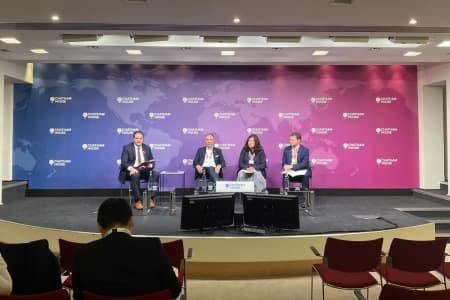
On Thursday, 3 November, Roger Coelho, Senior Policy Director, AmCham EU, moderated a panel on digital trade at Chatham House in London. The ‘harnessing the power of digital trade’ panel explored how digital trade agreements and international cooperation can become tools for integrating emerging technologies in the global economy.
The role of digital innovation in global trade
On Thursday, 3 November, Roger Coelho, Senior Policy Director, AmCham EU, moderated a panel on digital trade at Chatham House in London. The ‘harnessing the power of digital trade’ panel explored how digital trade agreements and international cooperation can become tools for integrating emerging technologies in the global economy.

The speakers described their concerns about the current digital regulatory environment – such as fragmentation and data localisation – and discussed strategies for overcoming recent trends towards digital protectionism.
The panellists included:
Rhys Bowen, International Director, Department for Digital, Culture, Media and Sport, United Kingdom
Mary Elizabeth Chelliah, Principal Trade Specialist, Ministry of Trade and Industry, Singapore
Ben Digby, Head of Global Trade Policy, HSBC
Minako Morita-Jaeger, Senior Research Fellow in International Trade, Department of Economics, UK Trade Policy Observatory, University of Sussex
The panel was part of Chatham House’s 2022 Global Trade Conference, which featured discussions on the effects of the green agenda on global trade and the future of supply chains. In times of uncertainty and instability, it is essential to promote constructive dialogue across all sectors and governments.
Related items
:focal())
Council vote clears way for landmark EU-Mercosur free trade agreement
EU Member States’ decision to approve the EU-Mercosur free trade agreement is a major victory for the EU’s free trade agenda. For companies in the EU, the agreement promises to support deeper integration of value chains and facilitate access to a market of 284 million consumers. This will contribute to more resilient and diversified supply chains, including access to critical raw materials essential for the EU’s economic security and industrial growth.
AmCham EU praises the European Commission for its work with Member States to ensure the deal benefits all sectors of the EU economy. By concluding Mercosur’s first trade agreement with a major global partner, the EU demonstrates its commitment to open and rules-based trade. The European Parliament must now approve the agreement without delay, so that – after 25 years of negotiations – businesses and citizens can start benefiting from this deal.
Reacting to the news, Malte Lohan, CEO, AmCham EU, stressed the importance of the agreement: ‘The Council’s decision is a timely one. In today’s world, the EU needs to boost its economic competitiveness and maintain its free trade leadership. The EU-Mercosur agreement ticks both boxes’.
‘The business case is clear; the geopolitical case is clear. It is now the Parliament’s job to see the agreement across the finish line’, he added.
:focal())
No further delays: the EU-Mercosur FTA is vital for a stronger Europe
The European Council’s decision to postpone its vote on concluding the EU-Mercosur free trade agreement (FTA) is a missed strategic opportunity that threatens the EU’s credibility as a reliable partner. After more than 20 years of negotiations, the EU is once again delaying one of its most ambitious and strategic trade agreements.
The EU-Mercosur FTA’s economic benefits are clear. At a time when strengthening competitiveness, economic growth and partnerships should be paramount, the FTA provides access to a market of 284 million consumers – reducing tariff and non-tariff barriers and supporting integrated supply chains.
Beyond its economic benefits, the EU-Mercosur FTA is also an important geopolitical tool. It would anchor a long-term strategic partnership with a key region and reinforce the EU’s role as a credible advocate of rules-based trade. Amid heightened geopolitical rivalry, postponement weakens the EU’s standing and its ability to conclude ambitious FTAs elsewhere.
The EU cannot afford further delays. The EU-Mercosur FTA is vital for the region’s competitiveness, resilience and global credibility. The European Council must promptly return to this file and conclude this FTA in January.
:focal())
STEMming the skills gap
By 2035, high-tech roles will make up a significant share of employment across the EU, yet many young people still lack the digital skills needed to succeed. Amazon is helping bridge this gap through initiatives in Poland and Spain. In Warsaw, the company supports STEM Kindloteka, a modern hub offering young people free, interactive workshops in coding, robotics and virtual reality. In Spain, Amazon is working with the Ministry of Education, Vocational Training and Sports to train 500,000 students in digital and technological skills by 2027. These efforts strengthen Europe’s talent pipeline and support long-term competitiveness. Learn more about Amazon’s commitment to digital skills development on Invested in Europe.
Policy priorities
Insights and advocacy driving Europe’s policy agenda. Our priorities support growth, innovation and a stronger transatlantic economy.
Membership
Connecting business and policymakers to strengthen the voice of American companies in Europe.