Towards a balanced, proportionate instrument on foreign subsidies
On Tuesday, 2 March AmCham EU published its position on the European Commission's White Paper to deal with distortive effects caused by foreign subsidies in the Single Market. The proposal is a positive step towards addressing practices which negatively impact both EU and non-EU companies. The Commission should, however, refrain from imposing unnecessary burdens on companies that may not be proportionate to the goals the Commission seeks to achieve. Read the paper here.

Related items
Making the Foreign Subsidies Regulation fit for purpose
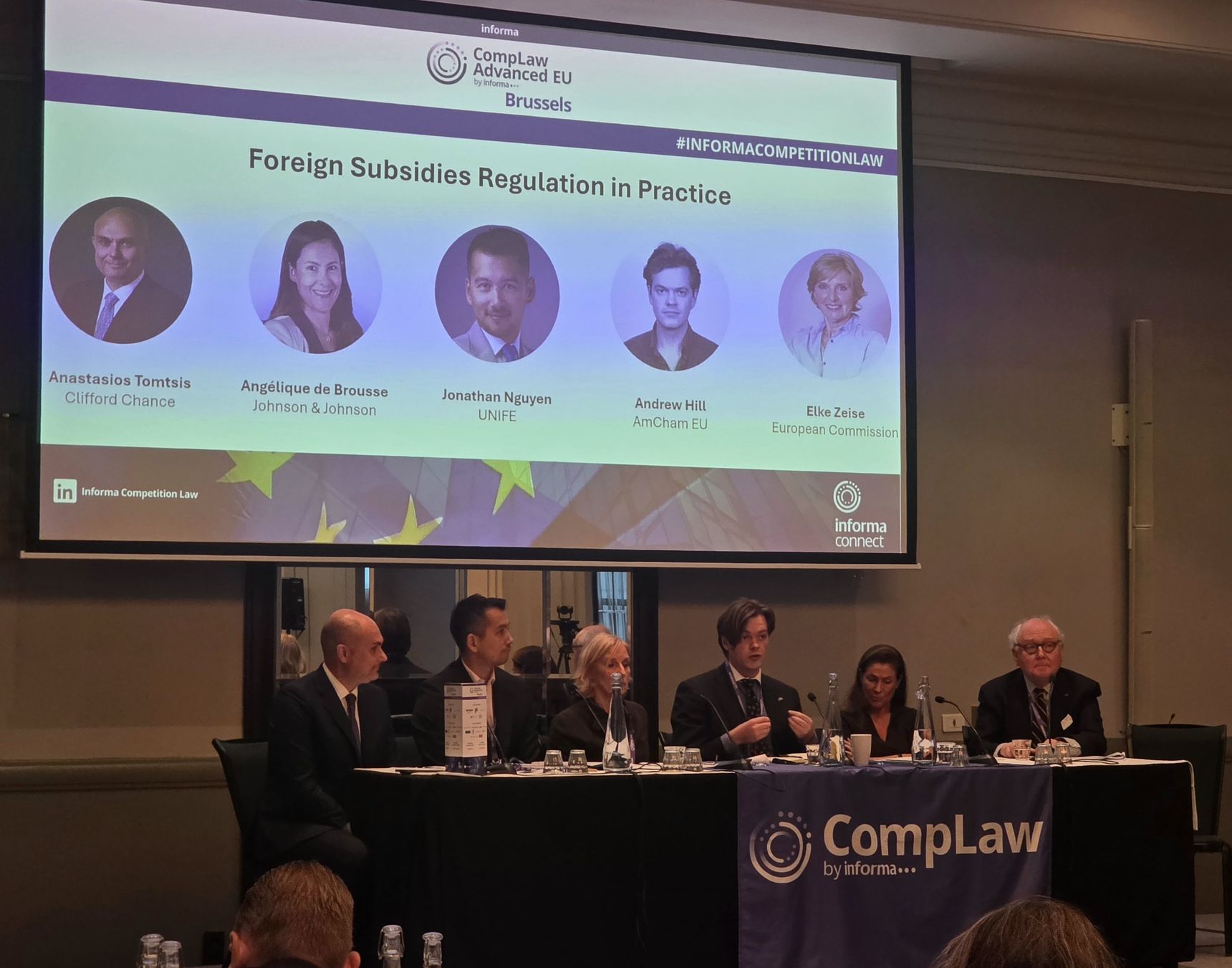
On Wednesday, 18 November, Andrew Hill, Senior Policy Adviser, AmCham EU, represented the organisation at the CompLaw: Advanced EU conference in Brussels. Joining a panel on how the Foreign Subsidies Regulation (FSR) works in practice, Mr Hill stressed the need for a more proportionate and risk-focused approach to the FSR. With potential changes to EU public procurement rules on the horizon that could restrict market access for companies not covered by international agreements, such as the Government Procurement Agreement (GPA), he highlighted the importance of adapting the FSR to reflect new enforcement realities and avoid unnecessary regulatory burdens. Streamlining the FSR would help the EU address genuine market distortions while preserving an open and predictable business environment. Learn how a proportionate FSR can support a stronger, more predictable business environment in Europe.

Supporting competitiveness, innovation and investment through the Merger Guidelines
The revised Merger Guidelines1 (‘Guidelines’) should ensure that the EU merger control framework supports competitiveness, innovation and investment while preserving legal certainty, predictability and effective competition. The Guidelines should remain firmly anchored in the significant impediment of effective competition (SIEC) test, apply resilience and scale considerations in a headquarters-neutral and effects-based manner, and provide clearer analytical and evidentiary standards for resilience assessments and the new theories of harm.
The Guidelines should recognise the benefits of scale where these deliver demonstrable advantages for EU consumers, apply the innovation shield consistently across all acquirers, maintain appropriate safe harbours and ensure a balanced and symmetrical assessment of harms and benefits. The Guidelines should also strengthen predictability across overlapping transaction review regimes and provide greater certainty for both EU and non-EU investors. Together, these refinements would help ensure that merger control contributes to competitiveness, innovation and economic growth while maintaining a transparent and proportionate enforcement framework.

FSR compliance: complexity undermining competitiveness
The EU proposed the Foreign Subsidies Regulation (FSR) in 2021 to address foreign subsidies distorting the Single Market. Operating as a screening instrument behind merger control, it requires companies to notify the European Commission of foreign financial contributions (FFCs) they may receive when participating in public procurement or mergers and acquisitions activity. Preventing FFCs from distorting the Single Market is an important goal – and one that must be achieved without creating its own disruptions.
Policy priorities
Insights and advocacy driving Europe’s policy agenda. Our priorities support growth, innovation and a stronger transatlantic economy.
Membership
Connecting business and policymakers to strengthen the voice of American companies in Europe.