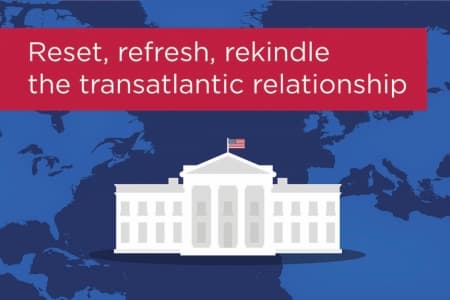
Beyond the domestic political arena, another area where unity must prevail is in the transatlantic relationship. Under strain since the negotiations on a Transatlantic Trade and Investment Partnership (TTIP) ended in stalemate, tensions have flared and threats of tariffs have foreshadowed cooperation. As CEO of the American Chamber of Commerce to the European Union, I call on the US and the EU to use the new presidential term as an opportunity to ‘reset, refresh and rekindle’ the transatlantic agenda.
Reset transatlantic relations
With President Biden now at the helm, both sides must seize the chance to reset the relationship and focus not on that which divides us, but that which unites. The EU-US economic relationship supports 16 million jobs on both sides of the Atlantic. It is worth one third of global GDP and accounts for half of global personal consumption. It is the largest economic relationship in the world. Both sides can surely agree that now is the time to dial back the adversarialism in favour of constructive proposals to rediscover common ground. The EU and the US should seek out sectors where barriers to trade and investment can be stripped away relatively easily (ie, manufacturing). The limited tariff reduction agreement concluded over the summer is a good example of avenues to advance a positive agenda. Both sides should certainly continue to seek opportunities to cooperate on emerging issues (ie, artificial intelligence) where they can lead the way in setting global standards. A high-level EU-US summit early into the new administration’s term would set the tone, by sending a message that both sides consider this partnership a priority.
Refresh multilateralism
Across the world, there has been a trend in recent years towards policies that put domestic interests first. However, prioritising the domestic at the expense of the international is short-sighted in the interconnected and globalised economy that we have built. In the face of common problems, including a global pandemic, or a climate crisis, no nation can absolve itself of its responsibility to engage with the wider world. For global challenges, we need global solutions – and to find such solutions, we require multilateral fora. As a business community, we agree that multilateral institutions such as the World Trade Organization (WTO) are imperfect in their current form. These institutions must be refreshed in order to make them fit for purpose in the twenty-first century. The US must engage constructively from within these institutions and alongside its partners and allies in Europe and beyond to shape this modernisation process. A good first step would be to resolve the stalemate surrounding the appointment of the WTO’s next Director-General.
Rekindle EU-US leadership
The EU and the US are bound by a common history, common democratic values and a sense of common destiny. Throughout their common history, Americans and Europeans have stood shoulder to shoulder to fight for a better future. In the current context, our societies face a host of new challenges. A geopolitical challenge in the form of China; an existential challenge by way of the climate emergency, and the need to adapt our economies to cleaner and more sustainable living; and a technological challenge as the digitalisation of our economies and societies becomes ever more far-reaching. The EU and the US must work together to coordinate their approach to these societal challenges. Together, they can use their combined economic weight to set global standards. Together, they can leverage their common democratic values to shape global governance structures. Together, they can lead the fight for a more sustainable and more prosperous future. Now more than ever we must rekindle EU-US leadership, lest rival geopolitical powers step in to fill the void.
As American businesses invested in and committed to Europe, we want to see the strongest possible transatlantic relationship. This is good for business; it is good for citizens; and it is good for our societies. A strong, outward-looking transatlantic relationship is the lynchpin to a prosperous and deeply interconnected global economy. The EU’s recently published proposal for ‘a new transatlantic agenda for global change’ recognises that the new US administration represents an opportunity to reset, refresh and rekindle our relationship. Each side must grasp it with both hands.
:focal())
:focal())
:focal())