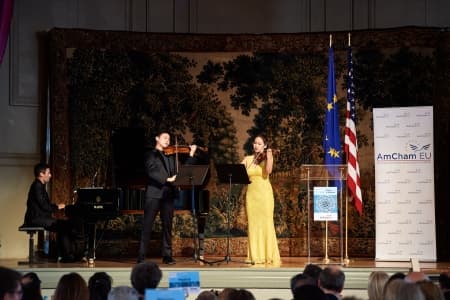
Queen Elisabeth Competition donations

The Queen Elisabeth Competition has been active since 1937 as one of the main music competitions of world-renowned importance. Only WWII had imposed a pause to the event prior to the COVID-19 postponement of the 2020 edition. The competition is relying mainly on private donations and needs financial support more than ever to go through this exceptional ordeal. Donations are vital and will make it possible for the Queen Elisabeth Competition to organise an outstanding and awaited piano edition next year, maintaining its standard of excellence.

News
18 Aug 2020
Queen Elisabeth Competition donations

AmCham EU is a long-standing supporter and a partner of the Queen Elisabeth Competition. This year, following the cancellation of our annual Gala and to express our support for the Arts in these exceptional circumstances, AmCham EU has decided to make a donation to the Queen Elisabeth Competition. Should you wish to contribute as well please click here. Donations are tax-deductible. For all details please visit the Queen Elisabeth Competition website

For your donation to be used towards the participation of US candidates and jury members in the 2021 competition, add ‘AmCham EU’ in the payment description.

You can also keep up with the Queen Elisabeth Competition by taking a look at their summer virtual events including Flagey on Air and Sessions d'été de Tempo

Related items

Position Paper
20 Jul 2026

Principles for economically efficient and growth-compatible tax reform in the EU

The Draghi report highlights how economic growth has stagnated in the EU due to structural weaknesses that risk undermining the EU’s global competitiveness. To bolster the EU’s attractiveness and competitiveness, lawmakers should pursue a coherent pro-growth tax reform agenda. A pro-growth tax reform agenda in the EU27 can be evaluated through five principles: (a) economic efficiency, including low distortion of economic decisions and low administrative and compliance costs; (b) consideration and strong discipline across the entire lifecycle of tax policy reform: initial decision making process, legal design and implementation; (c) evidence-based accountability through clear objectives, rigorous impact assessment, meaningful consultation and ex post review; (d) strengthening the Single Market rather than adding cross-border frictions; and (e) neutrality and fair competitive conditions across sectors, countries and business models.

These principles are mutually reinforcing: growth is supported not only by sound and coherent statutory design, but by the full tax system including law, administration and taxpayer interaction. AmCham EU has prepared a framework for EU lawmakers to use while designing, implementing and evaluating tax policy based upon our members’ experiences operating in every EU Member State and almost every country around the world.

Read more about Principles for economically efficient and growth-compatible tax reform in the EU
Blog
20 Jul 2026

Tax policy may not always make headlines – but its benefits certainly are

Tax
Simplification
Read more
Read more about Tax policy may not always make headlines – but its benefits certainly are
Position Paper
20 Jul 2026

Sustainable Finance Disclosure Regulation 2.0: getting the architecture right

The EU’s sustainable finance rules should help investors understand where their money is going and support Europe’s transition. The Commission’s proposal improves the current system, but some changes are still needed.

The new Transition category should focus on whether companies are cutting emissions, not on the sector they operate in. The 70% threshold should stay. The rules should also work with MiFID II and the EU Taxonomy.

Companies need 24 months to prepare. Firms that fall outside the new scope should stop reporting as soon as the rules enter into force.

Read the paper to learn how SFDR 2.0 can direct more capital towards Europe’s transition.

Financial services
Read more
Read more about Sustainable Finance Disclosure Regulation 2.0: getting the architecture right