New survey shows the resilience of the transatlantic economy

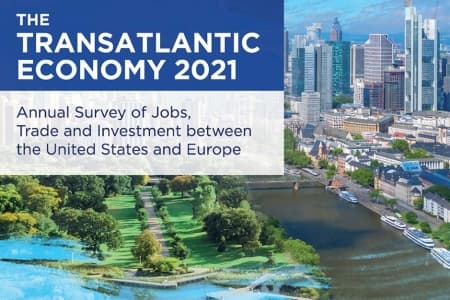
A new survey from the American Chamber of Commerce to the EU (AmCham EU) and the U.S. Chamber of Commerce reports that the transatlantic economy is on the mend, thanks to the massive policy response to the recession brought on by COVID-19. Both the EU and the US are set to see a return to growth in 2021, although the rebound is uneven with the US powering ahead. Turning to the future, the report notes that the fundamentals of the transatlantic relationship remain strong and will likely play a key role in the economic recovery to come. Read the report here.

News
23 Mar 2021
New survey shows the resilience of the transatlantic economy

Susan Danger, CEO, AmCham EU, said: 'We are encouraged by the strong political will on both sides to advance the transatlantic relationship. A strong recovery will depend on close cooperation between the EU and the US, as we battle the global health crisis and its impact on our economies.' She went on to say: 'Transatlantic partners must seize the opportunity to build a more resilient, sustainable and innovative economy. Now is the time for transatlantic leadership.'

The Transatlantic Economy 2021 annual survey highlights how the EU-US relationship remains the largest of its kind in the world. The transatlantic economic partnership generates around €6 trillion in commercial sales a year and accounts for half of total global personal consumption. No place in the world attracts more US foreign direct investment (FDI) than Europe. Over the past decade, Europe attracted 57.3% of total US global investment - more than in any previous decade.

What to look out for in this new edition?

  • Impact of the global pandemic on the transatlantic economy;

  • A new chapter devoted to the evolving relationship between the EU, the US and China;

  • Changing dynamics of post-Brexit relations with the UK;

  • Data on the transatlantic energy economy; and

  • Individual profiles for 30 European countries and all 50 US states.

The research was conducted independently by Daniel Hamilton and Joseph Quinlan for the Wilson Center's Global Europe Program and the Foreign Policy Institute at Johns Hopkins University's School of Advanced International Studies.

The data is also available on Thriving Together, an online platform that showcases the deep ties that bind Europe and the United States, including numbers from The Transatlantic Economy 2021. Visit the platform: thrivingtogether.eu.

Related items

News
7 Jul 2026

Branching out with AI

Meta’s open-source Canopy Height Maps helped the European Commission’s Joint Research Centre improve its 2020 Global Forest Cover map, demonstrating how artificial intelligence can strengthen Europe’s ability to monitor forests and advance climate and biodiversity goals. Developed with the World Resources Institute, the maps use Meta’s DINO self-supervised computer vision model to estimate tree height from satellite imagery. This helped researchers apply the five-metre threshold used in many international forest definitions and better distinguish forests from other tree-covered land, including agricultural tree crops. The resulting product, available through the EU Forest Observatory, provides one of the most comprehensive open views of global forest cover. Read more on Invested in Europe.

Digital
Read more
Read more about Branching out with AI
Blog
3 Jul 2026

The transatlantic relationship at 250 years: a shared history and a forged future

Authored by Malte Lohan, CEO, AmCham EU

Transatlantic
Read more
Read more about The transatlantic relationship at 250 years: a shared history and a forged future
News
3 Jul 2026

Advancing skills for Europe’s AI transition

On Tuesday, 30 June, AmCham EU hosted a roundtable exploring strategies for preparing Europe’s workforce for the age of artificial intelligence (AI). Members and policymakers analysed how AI is changing roles across sectors and how employers, governments and education providers can respond. Joined by Idoia Mendia, MEP (ES, S&D) and Mario Nava, Director-General, Directorate-General for Employment, Social Affairs and Inclusion, European Commission, the conversation focused on digital and data skills, as well as expanding AI literacy across organisations. Participants also discussed reskilling and public-private cooperation to support a more inclusive labour market. In addition, members shared best practices from their companies and pointed to the need for policy frameworks that support lifelong learning and skills-based hiring. As AI becomes part of everyday work, Europe must close the skills gap to strengthen competitiveness and prepare people for the future of work.

Social impact, inclusion and skills
Read more
Read more about Advancing skills for Europe’s AI transition