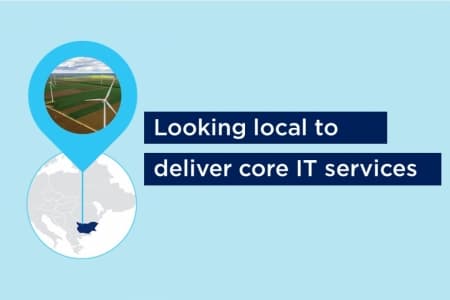
Looking local to deliver core IT services

The IT and digital team within AES Bulgaria delivers core IT and business services. For this, it relies on more than 10 local suppliers to provide IT infrastructure, telephone and cybersecurity services. For instance, the local service provider Telenor has optimised AES Bulgaria’s mobile phone bills by more than 50% due to its flexible and highly specialised workforce. Simultaneously, working with AES has given local suppliers like Telenor the chance of expanding beyond their local markets and developing innovative services. Read their story to find out how local parterships can help deliver core IT services.

News
7 Mar 2022
Digital
Looking local to deliver core IT services

AES Bulgaria is part of The AES Corporation in the Eurasia region covering markets from the Netherlands up to Vietnam. The Eurasia Shared Services Center, based in Sofia, delivers financial, IT, supply chain, human resources and communications services for the company’s businesses in five countries.

The AES IT and digital team is made up of 10 employees, who are spread across the businesses in the Eurasia region. In order to be able to deliver core IT and business services, AES relies on the services more than 10 local suppliers in areas such as IT infrastructure, telephony and cybersecurity. AES counts on local suppliers for a flexible workforce with a high degree of specialised skill and expertise, and rapid response capacities in order to ensure business continuity.

In its work with local telecoms providers in Sofia, the AES IT team has benefitted from suppliers’ willingness to go beyond their off-the-shelf service offering for their client. One such example is local telecoms provider Telenor, who was able to offer an innovative service for mobile phone cost management. The new service allowed every AES employee in Bulgaria to have visibility and control over their phone bill and especially over the roaming costs. Moreover, Telenor was able to offer so called pool-based services – such as internet and internet in roaming. This was a key achievement because as a consequence, the Bulgarian entities were able to optimise mobile phone bills by more than 50%. This innovation then went on to become a part of their wider service offering.

AES’ work with local suppliers is mutually beneficial. Aside from the obvious financial potential of working with such a big client, local suppliers can develop their own markets with innovative new services developed in tandem with their multinational client. Finally, working with a company with multinational presence provides potential to expand beyond local markets. Meanwhile, AES can continue to deliver reliable, affordable and sustainable energy to its Eurasia customers. 

Acknowledgement: Petar Radev, IT director, AES Eurasia Shared Services Center

The success story of global trade lies in strong partnerships between companies of all sizes. Find out more about European ecosystems connecting small businesses with larger American companies. 

Related items

News
7 Jul 2026

Branching out with AI

Meta’s open-source Canopy Height Maps helped the European Commission’s Joint Research Centre improve its 2020 Global Forest Cover map, demonstrating how artificial intelligence can strengthen Europe’s ability to monitor forests and advance climate and biodiversity goals. Developed with the World Resources Institute, the maps use Meta’s DINO self-supervised computer vision model to estimate tree height from satellite imagery. This helped researchers apply the five-metre threshold used in many international forest definitions and better distinguish forests from other tree-covered land, including agricultural tree crops. The resulting product, available through the EU Forest Observatory, provides one of the most comprehensive open views of global forest cover. Read more on Invested in Europe.

Digital
Read more
Read more about Branching out with AI
News
19 Jun 2026

Examining Europe’s AI ambitions with the Cypriot Presidency of the Council of the EU

How can Europe strengthen its digital resilience while remaining open to the partnerships that drive AI innovation? On Wednesday, 17 June, Malte Lohan, CEO, AmCham EU, addressed this at a conference organised by the Cypriot Presidency of the Council of the EU in Nicosia, Cyprus. Discussions focused on how Europe can build a more resilient digital ecosystem while remaining an attractive destination for investment and innovation. Mr Lohan underlined that secure supply chains and trusted partnerships are essential to Europe’s AI competitiveness. He also highlighted the role of US businesses as committed partners in helping Europe build and compete globally, while stressing the need for balanced policies that strengthen resilience and give companies the confidence to invest in Europe.

Presidency
Digital
Simplification
Read more
Read more about Examining Europe’s AI ambitions with the Cypriot Presidency of the Council of the EU
News
5 Jun 2026

Tech Sovereignty Package: positive steps for energy resilience, but a risky gamble for digital competitiveness

This week the European Commission unveiled its Tech Sovereignty Package. While the Package’s energy proposals mark a significant step forward for EU energy resilience, the Cloud and AI Development Act (CADA) proposal overlooks the reality of global technology supply chains and introduces significant legal uncertainty and fragmentation for businesses.

The central question for the Tech Sovereignty Package is how to build resilience without undermining competitiveness. Concerns around overdependence on a limited number of providers, the risk of external disruption to service continuity and the long-term position of the EU’s digital industries are all legitimate. However, greater sovereignty will only be sustainable if it is built on a competitive, diverse and innovative digital ecosystem. The technologies that underpin the global digital economy are developed through highly international supply chains, with innovation spread across multiple markets.

Viewed through this lens, the individual proposals in the Package vary in the extent to which they reinforce resilience while preserving openness and competitiveness. In particular, the proposed CADA risks discriminating against providers that rely on global supply chains – both those based in Europe and those in third countries – even where they offer superior resilience.

‘An origin-based approach is too blunt for such a complex global market’, said Malte Lohan, CEO of the American Chamber of Commerce to the European Union, commenting on the Package.

‘A more credible path to achieving greater resilience and control in such an interconnected landscape is to define sovereignty in terms of outcomes: secure and reliable technologies, customer choice, strong safeguards against undue interference and a business environment that supports investment and growth. That points to a risk-based framework where the EU is open to working with trusted partners. This trust should be assessed on the basis of objective standards rather than origin alone’, Mr Lohan added.

Last year alone, US technology firms operating in Europe and their supply chains supported €1.0 trillion in EU GDP, equivalent to 5.4% of total output. The scale of this contribution underscores the need for the EU to preserve an open environment with legal clarity and proportionality in any restrictions or safeguards that would impact commercial operations.

The Package’s Strategic Roadmap for Digitalisation and AI in energy is a positive step that could help unlock the benefits of digitalisation for Europe’s energy needs, enabling faster and more flexible grids. Digitalisation provides new opportunities to strengthen the reliability and resilience of energy systems. If executed well, the roadmap could support the growing demand of Europe’s digital and AI sectors for low-carbon energy.

Ultimately, the importance of the Tech Sovereignty Package extends well beyond the technology sector itself. Manufacturers, healthcare and life sciences, financial services, mobility, energy and retail all increasingly depend on access to advanced digital technologies to innovate and compete. For the Tech Sovereignty Package to support these sectors, it must ensure companies in Europe continue to benefit from economic openness.

Digital
Read more
Read more about Tech Sovereignty Package: positive steps for energy resilience, but a risky gamble for digital competitiveness