Learn more about this and other stories of American companies’ commitment to the communities they interact with and the places they call home on Invested in Europe.
Invested in Europe: how Oracle is transforming the European tech industry
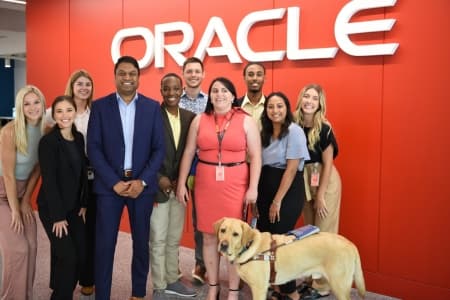
How can we provide the diverse talent the European technology industry needs? Oracle answers this question with a range of initiatives aimed at upskilling underrepresented communities. Launched in 2017, Oracle4Girls seeks to inspire girls in Spain between the ages of four and 16 to become involved in STEM. Similarly, Reinventa-Tech was set up in 2020 in the midst of the pandemic to train women to fill available technical roles. Finally, Generation Oracle provides people from all backgrounds with the opportunity and resources to break into the technology industry. Each of these important programmes is changing the status quo and making the digital workplace more diverse.
Related items
:focal())
Blog
14 Oct 2026
The Single Market is only as simple as its Member States make it
This blog is authored by Malte Lohan, CEO, AmCham EU.
What exactly is ‘single’ about a market where the same product needs different national markings, a cyber incident can require dozens of reports and a professional qualification may stop being recognised at the border?
These examples come from different sectors, but they point to the same contradiction. The EU creates common rules, yet companies still encounter national requirements that divide Europe into separate markets in practice.
The stakes are high for American companies invested in Europe. The United States is the largest single source of inward foreign direct investment (FDI) into the EU. In 2025, American companies invested more in Europe (53%) than they did the rest of the world combined. This has been the case for decades. Much of this appeal lies in the promise of a large, prosperous Single Market.
Yet there are signs that this position is coming under pressure. While Europe remains the leading destination for US investment, its share of total US outward FDI has fallen to its lowest level in more than four decades. More recent indicators point in the same direction too. EY’s 2026 European Investment Monitor found that 943 US companies invested in Europe last year, 16% below the annual average of 1,124 over the previous five years. To reverse these trends, Europe needs to make itself a more attractive place to invest, beginning with a more integrated Single Market.
That is why the simplification agenda cannot lose steam – in Brussels and national capitals. In her September State of the Union address, European Commission President Ursula von der Leyen highlighted the need for EU-wide coordination. ‘Simplification cannot be a one-way street’, she said. ‘All levels have to have skin in the game’.
As EU leaders check in on progress under the ‘One Europe, One Market’ roadmap at this week’s European Council meeting, they should look closely at how national choices affect companies operating across borders. That means addressing three related but distinct problems: gold-plating, uneven implementation and the national barriers that continue to fragment the Single Market.
:focal())
News
13 Oct 2026
From fryer to fuel
After frying frites, bitterballen, churros or arancini, many people don’t think twice about disposing of used cooking oil. Yet one litre of waste oil can contaminate one million litres of water, according to the European Commission. At Cargill’s facility in the port of Ghent, Belgium, used cooking oil and other residual oils and fats are treated as raw materials, cleaned and converted into biodiesel for trucks and ships. This puts circularity into practice on an industrial scale at one of Europe’s largest facilities of its kind. Since production began, Ghent’s biodiesel is estimated to have reduced greenhouse gas emissions by 1,188,000 tonnes compared with fossil diesel, equivalent to taking about 550,000 cars off the road for a year. Read the full story on Invested in Europe.
:focal())
News
5 Oct 2026
Making the case for the transatlantic relationship in Washington, DC
From Monday, 28 September to Thursday, 1 October 2026, AmCham EU led a delegation of members to Washington, DC to bring the views of the business community to policymakers in Congress and the administration. Discussions showed that both sides value the stability the Turnberry framework agreement brings. While parts of the agreement remain to be implemented, meetings pointed to the possibility for cooperation on economic security. Implementation will continue to need dialogue between the two sides, which is expected to carry on after the mid-term elections.
Policy priorities
Insights and advocacy driving Europe’s policy agenda. Our priorities support growth, innovation and a stronger transatlantic economy.
Membership
Connecting business and policymakers to strengthen the voice of American companies in Europe.