The future of the TTC: from Paris and beyond
On Tuesday, 17 May, AmCham EU hosted an event exploring the outcomes of the Trade and Technology Council’s Paris Summit. The panellists sought to analyse the outcomes of the Summit in the context of transatlantic cooperation in the digital sphere and of the current European digital legislative priorities. Susan Danger, CEO, AmCham EU moderated the panel, which featured Eva Maydell, MEP (EPP, BG); Thibaut Kleiner, Director, Policy Strategy and Outreach, Directorate-General for Communications Networks, Content and Technology, European Commission; and Jean-Marc Leclerc, Director, EU Affairs, IBM and Co-director, IBM Policy Lab.

Related items

Export controls fit for today's economy
The Dual-Use Regulation gives Europe a common framework for economic security, but divergent national implementation is weakening it. The same transaction can be assessed differently depending on the Member State, with guidance on cloud and software-as-a-service transfers remains unclear. Licensing processes, meanwhile, still assume a physical consignment rather than digital workflows, which sits poorly with how integrated global businesses operate. Companies bear the added cost and legal uncertainty, while the security benefit is limited. A single EU-wide approach to intangible transfers and closer alignment with the US and UK would make controls more predictable and let authorities focus on genuine risks. Read how the revision of the Dual-Use Regulation can deliver a harmonised and future-proof framework for Europe.

Making CADA’s sovereignty framework work for Europe
The success of the Cloud and AI Development Act (CADA) will depend on whether its sovereignty framework strengthens Europe’s resilience and competitiveness without restricting access to the technologies, providers and operating models needed to support the bloc’s digital transformation. As currently envisaged, several elements of CADA introduce origin-based restrictions that are not necessarily linked to genuine sovereignty, security or resilience risks. These measures could reduce competition, increase costs and slow cloud and AI adoption – ultimately working against CADA’s underlying objectives.
A sovereignty framework built on objective, risk-based criteria will better support Europe’s competitiveness, resilience and digital transformation than one based on origin, ownership or nationality.
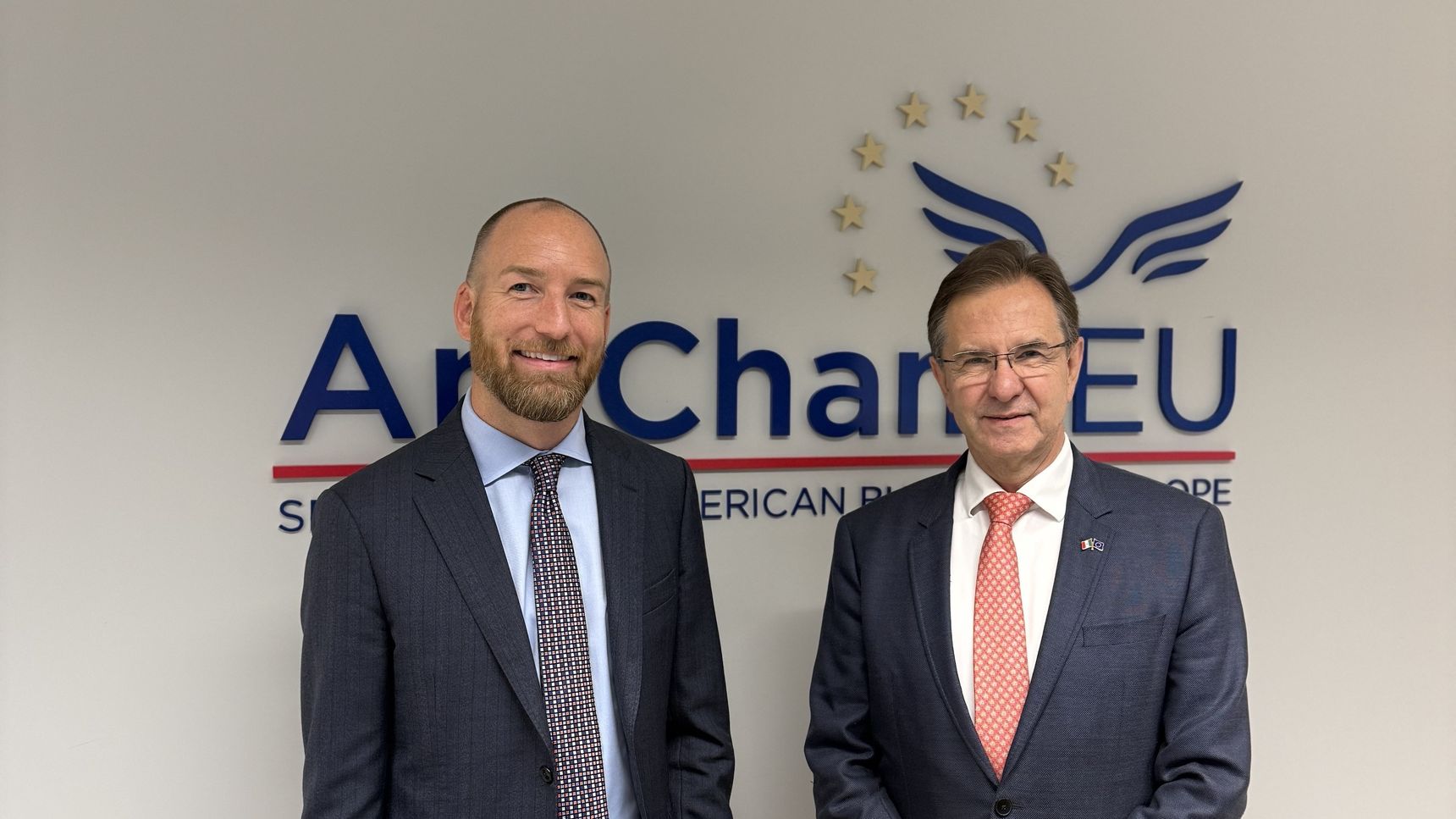
Engaging with the Mexican Ambassador on stronger trade ties
On Wednesday, 2 September 2026, Malte Lohan, CEO, AmCham EU met with Esteban Moctezuma Barragán, Mexican Ambassador to the European Union, Belgium and Luxembourg, for an introductory meeting to exchange views on the transatlantic business relationship. Discussions focused on opportunities to deepen EU–Mexico economic ties following the signature of the Modernised Global Agreement and interim trade agreement earlier this year. AmCham EU looks forward to continued engagement with Ambassador Moctezuma and to supporting closer EU–Mexico economic cooperation.
Policy priorities
Insights and advocacy driving Europe’s policy agenda. Our priorities support growth, innovation and a stronger transatlantic economy.
Membership
Connecting business and policymakers to strengthen the voice of American companies in Europe.