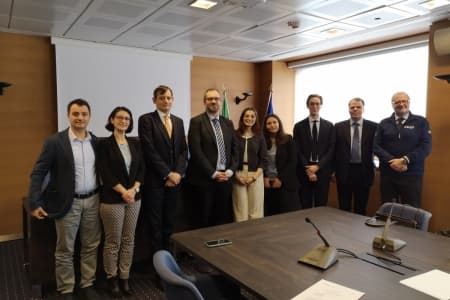
During the trip, AmCham EU met with Mario Carere, Senior Researcher, Italian National Institute of Health; Pasqualino Rossi, Director, Italian Ministry of Health; Stefania Minestrini, Italian Institute for Environmental Protection and Research and Enrico De Zorzi, Researcher, Italian Institute for Environmental Protection and Research. They also met with Fiorenza Barazzoni, Coordinator and Aurelio La Torre, Coordinator, Italian Ministry of EU Affairs. Rounding out the trip, they held meetings with Dania Esposito, Head, Hazardous Substances Unit and Carlo Piscitello, Research Assistant, Italian Institute for Environmental Protection and Research.
Forging environmental ties in Rome
From Monday, 13 November to Wednesday, 15 November, AmCham EU visited Rome, Italy to discuss top-line environmental topics. Delegates discussed a wide range of issues pertaining to chemicals and circular economy. Throughout the trip, delegates met with a variety of Italian ministries to build closer relationships at a member state level.
Related items
:focal())
News
13 Oct 2026
From fryer to fuel
After frying frites, bitterballen, churros or arancini, many people don’t think twice about disposing of used cooking oil. Yet one litre of waste oil can contaminate one million litres of water, according to the European Commission. At Cargill’s facility in the port of Ghent, Belgium, used cooking oil and other residual oils and fats are treated as raw materials, cleaned and converted into biodiesel for trucks and ships. This puts circularity into practice on an industrial scale at one of Europe’s largest facilities of its kind. Since production began, Ghent’s biodiesel is estimated to have reduced greenhouse gas emissions by 1,188,000 tonnes compared with fossil diesel, equivalent to taking about 550,000 cars off the road for a year. Read the full story on Invested in Europe.
:focal())
Position Paper
2 Jul 2026
Industry calls for stable and evidence-based implementation of the Single-Use Plastic Directive
Together with nine other associations, AmCham EU has signed a joint statement on the evaluation of the Single-Use Plastic Directive (SUPD), calling on EU institutions to avoid reopening the Directive. A revision at this stage would create uncertainty for operators and could also increase costs and deepen fragmentation across the Single Market. Several SUPD provisions are not yet in place. Data on implementation remain limited, making it too early to assess whether the Directive is meeting its objectives. The statement also underlines the need to address gaps in transposition and enforcement. It warns against overlaps with EU legislation such as the Ecodesign Regulation, the Packaging and Packaging Waste Regulation and the Circular Economy Act. Learn how the EU can support certainty and the Single Market in the joint statement.
:focal())
News
27 May 2026
The Circular Economy Act: a silver bullet for harmonisation?
On Wednesday, 27 May, AmCham EU hosted Paulina Dejmek Hack, Head of Cabinet for Jessika Roswall, Commissioner for Environment, European Commission, for a discussion on the upcoming Circular Economy Act. Moderated by Luca Ibelli (Procter & Gamble), Vice-Chair, Environment Committee, AmCham EU, the exchange explored how the Act can support Europe’s wider simplification agenda by reducing fragmentation and strengthening competitiveness. Participants also discussed the importance of a harmonised framework grounded in a clear business case, ensuring circular economy policies help companies operate effectively across the Single Market.
Policy priorities
Insights and advocacy driving Europe’s policy agenda. Our priorities support growth, innovation and a stronger transatlantic economy.
Membership
Connecting business and policymakers to strengthen the voice of American companies in Europe.