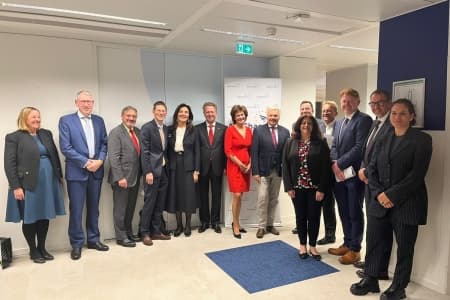
What role can business play in boosting the attractiveness of Europe? That was one of the questions AmCham EU's Executive Council explored during its autumn plenary over Monday, 6 November and Tuesday, 7 November. The group met in Brussels for a series of internal planning meetings and external discussions with high-level stakeholders. Throughout the two days, conversations centred around the difficult geopolitical landscape, what can be done to strengthen the Single Market, how the private sector can engage with the EU institutions ahead of the upcoming elections and the importance of aligning with likeminded partners.
Engaging European leaders with our Executive Council
What role can business play in boosting the attractiveness of Europe? That was one of the questions AmCham EU's Executive Council explored during its autumn plenary over Monday, 6 November and Tuesday, 7 November. The group met in Brussels for a series of internal planning meetings and external discussions with high-level stakeholders. Throughout the two days, conversations centred around the difficult geopolitical landscape, what can be done to strengthen the Single Market, how the private sector can engage with the EU institutions ahead of the upcoming elections and the importance of aligning with likeminded partners.

Take a look below for the full list of who the group met with.
Vsevolod Chentsov, Head of the Mission of Ukraine to the European Union
Valdis Dombrovskis, Executive Vice-President and European Commissioner for Trade
Mark Gitenstein, US Ambassador to the EU
Antoine Kasel, Head of Cabinet for Commissioner Schmit, European Commissioner for Jobs and Social Rights
Didier Reynders, European Commissioner for Justice and Competition
Stefano Sannino, Secretary-General, European External Action Service
Klaus Welle, Academic Council Chairman, Martens Centre and Former Secretary-General, European Parliament
Learn more about our Executive Council.
Related items
:focal())
No further delays: the EU-Mercosur FTA is vital for a stronger Europe
The European Council’s decision to postpone its vote on concluding the EU-Mercosur free trade agreement (FTA) is a missed strategic opportunity that threatens the EU’s credibility as a reliable partner. After more than 20 years of negotiations, the EU is once again delaying one of its most ambitious and strategic trade agreements.
The EU-Mercosur FTA’s economic benefits are clear. At a time when strengthening competitiveness, economic growth and partnerships should be paramount, the FTA provides access to a market of 284 million consumers – reducing tariff and non-tariff barriers and supporting integrated supply chains.
Beyond its economic benefits, the EU-Mercosur FTA is also an important geopolitical tool. It would anchor a long-term strategic partnership with a key region and reinforce the EU’s role as a credible advocate of rules-based trade. Amid heightened geopolitical rivalry, postponement weakens the EU’s standing and its ability to conclude ambitious FTAs elsewhere.
The EU cannot afford further delays. The EU-Mercosur FTA is vital for the region’s competitiveness, resilience and global credibility. The European Council must promptly return to this file and conclude this FTA in January.
:focal())
AmCham EU confirms Liam Benham for second mandate as Chair of its Board of Directors
The American Chamber of Commerce to the European Union (AmCham EU) has confirmed Liam Benham, President, EU, NATO and Government Affairs, Europe, Boeing, for a second mandate as Chair of its Board of Directors. We look forward to continuing our work with Liam as he brings his expertise and leadership to advancing AmCham EU’s strategic priorities.
:focal())
Exploring transatlantic ties at AmCham Luxembourg
On Tuesday 2 December, Thibaut L’Ortye, Senior Director of Public Affairs, AmCham EU presented The Transatlantic Economy 2025 report at AmCham Luxembourg’s Transatlantic Trade and Investment event. Stacey Feinberg, US Ambassador to Luxembourg highlighted the strong ties between Luxembourg and the US, with over 150,000 people employed thanks to the partnership. During his section, Mr L’Ortye presented the results of the report, with a particular focus on the resiliency of the EU-US relationship. Despite differing views on certain issues, the transatlantic partnership remains the most integrated in the world, directly responsible for 16 million jobs and one third of global GDP.
Policy priorities
Insights and advocacy driving Europe’s policy agenda. Our priorities support growth, innovation and a stronger transatlantic economy.
Membership
Connecting business and policymakers to strengthen the voice of American companies in Europe.