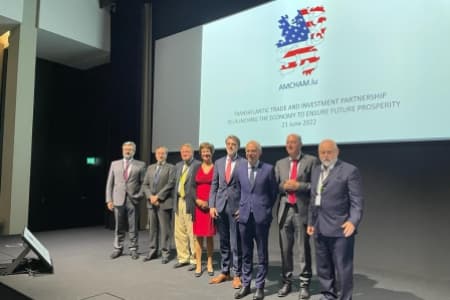
Discussing transatlantic trade and investment in Luxembourg

What is the future of the transatlantic economic relationship? That was the question Susan Danger, CEO, AmCham EU looked to address in her remarks during the event organised by AmCham Luxembourg, together with Deloitte and the Luxembourg American Chamber of Commerce on Tuesday, 21 June. Cooperation and collaboration were key themes throughout her remarks, underscoring their importance in generating economic growth. 

News
23 Jun 2022
Discussing transatlantic trade and investment in Luxembourg

She continued by strongly condemning the war in Ukraine and praised the close collaboration between the EU and the US in confronting common challenges. She went on to discuss how AmCham EU, as well as the AmChams in Europe network, supports the EU-US Trade and Technology Council (TTC) as a forum for regulatory and legislative cooperation.  

In the spirit of cooperation, AmCham EU and the US Chamber of Commerce, with the support of AmCham Luxembourg and other AmChams, produced the Transatlantic Economy Report 2022. Researched and written independently by Johns Hopkins University researchers, the report confirms what the speakers were highlighting – that the transatlantic relationship is not only resilient, but more important than ever.  

The event featured comments from speakers including Daniel S. Hamilton, Senior Fellow, Johns Hopkins University SAIS Foreign Policy Institute (FPI); Casey Mace, Chargé d’Affaires, US Embassy in Luxembourg; John Psaila, CEO, Deloitte Luxembourg; and Paul Schonenberg, Chairman and CEO, AmCham Luxembourg. The tenor of the evening was optimistic, as speakers emphasised the resilience of transatlantic trade and investment in the face of recent crises. In order to push progress forward, however, many of the speakers called on the EU to complete the Single Market, and for the US to remain a reliable, multilaterally minded partner.  


Related items

Position Paper
14 Jul 2026

Recalibrating the EU ETS: delivering decarbonisation without deindustrialisation

Europe’s carbon market must cut emissions without cutting industrial production. In some industries, emissions have fallen alongside output and plant closures. The EU ETS revision should ensure that progress towards 2050 comes from investment and technology, not deindustrialisation. 

The Linear Reduction Factor should be adjusted after 2030 so allowances remain available through 2050. ETS revenues should support decarbonisation projects, while free allocation should continue where alternatives are not available at scale. 

For aviation and maritime transport, EU rules should align with international frameworks. Data centres should be removed from the scope where emissions come mainly from backup generators. These changes would link emissions reductions to investment while limiting the relocation of production outside Europe. 

Industry
Read more
Read more about Recalibrating the EU ETS: delivering decarbonisation without deindustrialisation
News
14 Jul 2026

Securing Europe’s place in global life sciences

On Tuesday, 14 July, AmCham EU hosted Csaba Kontor, Policy Assistant, Cabinet of European Commissioner Olivér Várhelyi, for a discussion on strengthening Europe’s competitiveness in the life sciences sector. Moderated by Katerina Valkova (Bristol Myers Squibb), Chair, Healthcare Committee, AmCham EU, the exchange explored how policy decisions can support investment through research and innovation while ensuring patients in Europe can access health innovation. Participants also discussed the importance of resilient EU-US supply chains and regulatory cooperation, as well as the need to avoid divergence and provide the scale and predictability required to sustain Europe’s position as a leading destination for life sciences investment.

Healthcare
Read more
Read more about Securing Europe’s place in global life sciences
News
14 Jul 2026

A greener Emerald Isle, a more future-ready Éire

Amazon has been active in Ireland for more than 20 years, investing in its operations, supporting small and medium-sized enterprises and contributing to communities across the country. Through recent projects in energy and education, the company is helping Ireland advance its climate and digital skills ambitions. In partnership with EnergyCloud Ireland, Amazon is supporting 500 families in Fingal with free tanks of hot water powered by surplus renewable energy. At the same time, the company is donating digital technology kits to every primary school in Ireland, helping teachers bring coding, computational thinking and digital literacy into the classroom. These initiatives show how private sector collaboration can support greener homes, stronger schools and a more future-ready Ireland. Read the full story on Invested in Europe.

Social impact, inclusion and skills
Read more
Read more about A greener Emerald Isle, a more future-ready Éire