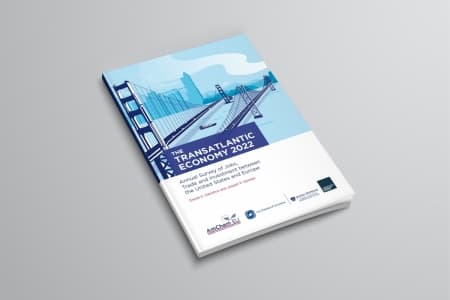
A new survey from the American Chamber of Commerce to the EU (AmCham EU) and the U.S. Chamber of Commerce reports that the transatlantic trade and investment relationship hit record-breaking numbers in 2021. The findings come out against a difficult political and economic backdrop, with the war raging in Ukraine and after two years of the COVID-19 pandemic. Inflation, congested supply chains, scarcity of raw materials and energy prices also add to global uncertainty. Despite this, the report demonstrates the resilience of the transatlantic economy and outlines avenues to strengthen the EU-US partnership with initiatives such as the Trade and Technology Council. To download the study, please click here.
2021 was a record-breaking year for the transatlantic economy, new report shows
A new survey from the American Chamber of Commerce to the EU (AmCham EU) and the U.S. Chamber of Commerce reports that the transatlantic trade and investment relationship hit record-breaking numbers in 2021. The findings come out against a difficult political and economic backdrop, with the war raging in Ukraine and after two years of the COVID-19 pandemic. Inflation, congested supply chains, scarcity of raw materials and energy prices also add to global uncertainty. Despite this, the report demonstrates the resilience of the transatlantic economy and outlines avenues to strengthen the EU-US partnership with initiatives such as the Trade and Technology Council. To download the study, please click here.

The Transatlantic Economy 2022 highlights how the EU-US relationship remains the largest of its kind in the world. The transatlantic economic partnership generates around €5.5 trillion ($6 trillion) in commercial sales a year and accounts for half of total global personal consumption. No place in the world attracts more US foreign direct investment (FDI) than Europe. Since the beginning of this decade, Europe has attracted 62.6% of total US global investment.
In 2021, transatlantic trade in goods reached €1 trillion ($1.1 trillion). US foreign direct investment (FDI) flows to Europe rose to €230 billion ($253 billion), while US foreign affiliate income earned in Europe amounted to an estimated €272 billion ($300 billion) – 2.7 times more than income earned in all of Asia.
What to look out for in this new edition?
How the war in Ukraine affects the US and European economies
What COVID-19, trade spats and congested supply chains mean for the transatlantic economy
How US-Europe commercial relations compare with those each has with China and others
Data on the rise of the transatlantic energy economy
Changing dynamics of post-Brexit relations with the UK
Individual profiles for 30 European countries and all 50 US states
The research was conducted independently by Daniel Hamilton and Joseph Quinlan at the Foreign Policy Institute, School of Advanced International Studies, Johns Hopkins University and the Transatlantic Leadership Network.
The data is also available on Thriving Together, an online platform that showcases the deep ties that bind Europe and the United States, including numbers from The Transatlantic Economy 2022. Visit the platform: thrivingtogether.eu.
The American Chambers of Commerce in Denmark, Finland, Greece, Ireland, Luxembourg and Sweden are partners of this year’s edition.
Related items
Guiding the next generation of leaders
On Wednesday, 25 March, Malte Lohan, CEO, AmCham EU spoke at the EU-US Young Leaders Summit in a seminar organised by Fulbright and the German Marshall Fund, focused on business leadership in times of economic disruption. Mr Lohan underlined that companies are operating in an increasingly complex environment, shaped by geopolitical tensions and diverging EU and US policy approaches. He also stressed the importance of a strong transatlantic economy and called for a pragmatic approach that supports cooperation and avoids further fragmentation.
:focal())
EU-US deal: European Parliament reaches position on tariff reductions
Today the European Parliament adopted its negotiating position on proposals to reduce tariffs on certain imports from the United States, in line with the July 2025 EU-US Framework Agreement. The Parliament’s vote clears the way for trilogues to finalise these proposals.
Reacting to the vote, Malte Lohan, CEO, AmCham EU, welcomed the Parliament’s decision as a necessary step towards a more predictable transatlantic marketplace: ‘The Parliament today has taken a decision that helps put the EU-US trade and investment relationship back on track. It is the right signal for businesses that have been stuck in limbo over the past year.’
‘AmCham EU opposes broad-based tariffs. However, given political priorities on both sides of the Atlantic, we still see the Framework Agreement as the most realistic route to securing a more constructive EU-US trade and investment climate’, Mr Lohan added. ‘We call on the Parliament and Member States to conclude trilogues swiftly. Once the tariff reductions are approved, the EU and the US can get back to advancing the cooperation the Framework Agreement envisages on a range of areas that benefit European and American businesses alike. We look to both sides to continue honouring their commitments throughout this process.’
:focal())
Preserving transatlantic trade in uncertain times
On Tuesday, 24 March, AmCham EU hosted Leopoldo Rubinacci, Deputy Director-General, Directorate-General for Trade, European Commission, to discuss the changing landscape of transatlantic trade in a context of rising protectionism and uncertainty. The meeting was timely as Transatlantic stakeholders eagerly wait for the European Parliament vote on Thursday, 26 March, on the EU-US Framework Agreement. The discussion also looked at differences in areas such as tariffs, industrial policy and market access, and how these affect businesses operating across the Atlantic. The importance of continued dialogue and cooperation to manage these challenges and avoid further disruption to global trade was also highlighted.
Policy priorities
Insights and advocacy driving Europe’s policy agenda. Our priorities support growth, innovation and a stronger transatlantic economy.
Membership
Connecting business and policymakers to strengthen the voice of American companies in Europe.